
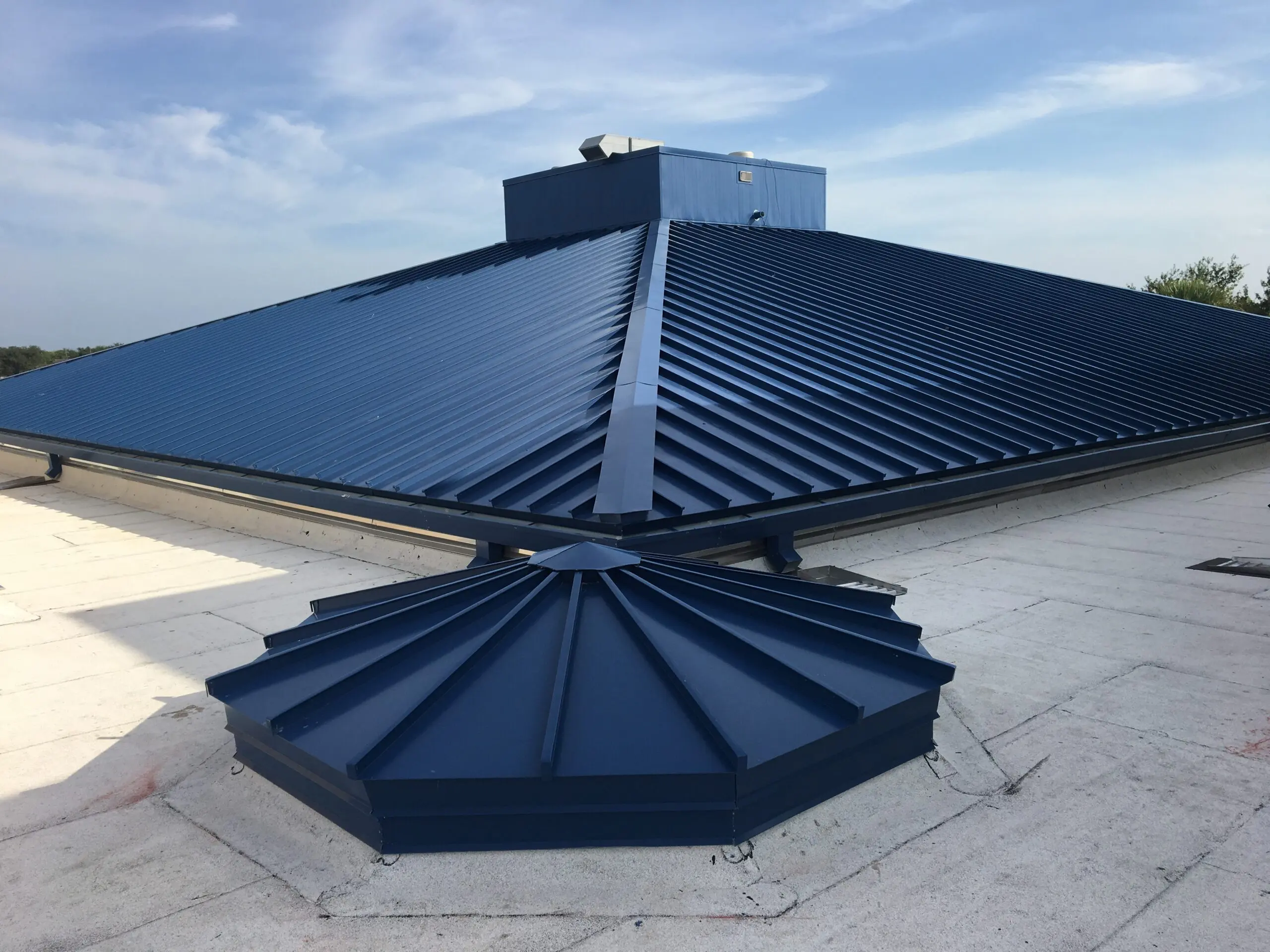
Standing Seam Metal Roofing for commercial buildings across Dayton, Montgomery County, Kettering, Beavercreek, Fairborn, Huber Heights, Vandalia, Miamisburg, Centerville, Springboro, Troy, Xenia, and the Miami Valley.
Standing seam metal roofing is the premium metal roofing specification for Dayton commercial construction — the choice that separates the defense contractor campuses in Beavercreek, the mixed-use development at Austin Landing in Miamisburg, and the quality corporate buildings along the I-675 corridor from the exposed-fastener industrial stock of Northwoods and Moraine. The concealed-fastener design that defines standing seam — structural connection clips hidden within the standing seam, no fasteners penetrating the panel face — is the feature that eliminates the most common failure mode of metal roofing in Dayton's climate: fastener backout and associated leak paths. On a standing seam system, the roof panel surface has no penetrations, and thermal expansion and contraction is accommodated through the floating clip connection rather than resisted by fixed panel-to-substrate fasteners.
WPAFB contractor campuses and defense-adjacent corporate facilities in Beavercreek represent the largest concentration of standing seam metal roofing in the Dayton market. The combination of corporate image requirements, long ownership horizons (defense contractors occupying facilities for decades-long contract periods), and preference for low-maintenance systems with predictable long-term performance makes standing seam an attractive specification for this market segment. A standing seam system with a 40-year Kynar paint warranty and concealed-fastener design requires dramatically less maintenance over its life than an equivalent exposed-fastener R-panel system — no fastener retightening programs, no sealant replacement at panel joints, and a panel that moves freely with thermal cycling rather than accumulating fatigue at fixed fastener points.
Thermal movement management is the engineering consideration that standing seam handles better than any other metal roofing system, and it's particularly important in Dayton's climate. The Miami Valley experiences a full seasonal temperature range of approximately 110°F — from below-zero winter nights to 100°F+ summer days — and standing seam panel systems accommodate this range through thermal movement across the panel length. A 100-foot standing seam panel run accommodates approximately one inch of thermal movement longitudinally between its extreme conditions. The floating clip design allows each panel to expand and contract freely over the clip as temperature changes without buckling or pulling fasteners. On large corporate campus buildings in Beavercreek where panel runs are long and building skin temperatures swing dramatically between seasons, this thermal accommodation is a real performance differentiator.
Austin Landing in Miamisburg represents a different standing seam context — a mixed-use development where architectural roof systems serve visual and identity functions as much as purely protective functions. Standing seam panels on Austin Landing's retail and restaurant buildings are visible from pedestrian-level vantage points and from the I-75 corridor approach, making panel profile, color, and finish quality elements of the development's brand identity. For these applications, panel selection goes beyond structural performance specifications to include aesthetic considerations: panel width, seam height profile, Kynar color matching to adjacent materials, and detailing at transitions to other cladding systems. Architects and building owners in Dayton's mixed-use development market have an increasingly sophisticated vocabulary for standing seam specification as the material has become more common in the regional commercial vocabulary.
Panel selection for Dayton standing seam applications involves gauge, width, profile height, material (steel vs. aluminum), and coating specification. 24-gauge Galvalume steel is the baseline commercial specification — heavier than residential metal roofing, lighter than structural metal deck applications. Aluminum standing seam is specified where corrosion resistance is the primary concern or where weight is a limiting factor; its slightly lower structural performance compared to 24-gauge steel and different thermal expansion characteristics require design attention. Kynar 500 fluoropolymer coating (30-year paint warranty from major manufacturers) is the standard commercial specification for exposed Dayton applications; standard polyester coatings used in lower-cost panel lines have significantly shorter useful coating lives in this climate's UV and thermal cycling environment.
Underlayment specification for standing seam on Dayton commercial buildings affects both thermal performance and condensation management. In heated commercial buildings, the temperature differential between the warm interior and the cold exterior panel surface creates condensation potential — warm interior air can contact the underside of cold metal panels and deposit moisture within the insulation assembly if vapor management is not designed correctly. Self-adhered vapor retarder underlayments beneath thermal insulation layers, combined with ventilated air space at the panel underside in some applications, manage this condensation risk. For Dayton commercial buildings with variable interior humidity conditions — food service, manufacturing, or laboratory facilities — vapor management in the standing seam assembly deserves specific engineering attention rather than being treated as a generic specification item.
Snow retention systems are a standing seam installation consideration for Dayton commercial buildings on sloped roofs where slide-off snow would affect pedestrian areas, building entrances, or adjacent property. Standing seam metal roofing provides very little surface friction — snow accumulation on a metal panel can release suddenly during the melt cycle that follows a Dayton snowfall, depositing large volumes of snow at the roof edge. Snow retention bars, pipe-style snow guards, or individual pad-style snow guards are mounted to the standing seam through specialized clamps that attach to the seam without penetrating the panel face — maintaining the concealed-fastener integrity of the standing seam system. For Dayton buildings where pedestrian activity occurs below sloped metal roofing, snow retention is a safety requirement that should be part of the original specification rather than an afterthought.
Re-roofing with standing seam over existing commercial buildings in Dayton is a viable option for buildings that currently have aged flat roofing systems but where the structural framing can accept the slight additional dead load of the new standing seam assembly. Installing a structural standing seam system over an existing low-slope building — raising the roof slope through a new structural framing layer — is a more involved project than a simple membrane replacement, but it transforms a chronically flat-roof-problem building into one with positive slope drainage, long-term low maintenance requirements, and dramatically improved storm performance. Several Dayton commercial building owners have executed this type of conversion on industrial and commercial buildings where recurring flat-roof problems had become a sustained management burden.
Quality standing seam metal roofing with Kynar coating is specified for 40 to 50 years of service life in Dayton's climate with routine maintenance. The concealed-fastener design eliminates the primary failure mode of exposed-fastener metal roofing (fastener backout and associated leak paths), and properly coated Galvalume steel maintains its structural and aesthetic performance through decades of Dayton's freeze-thaw cycling and severe weather events. The primary maintenance items are periodic paint touchup on any impact damage or exposed cut edges, gutter and drainage system maintenance, and inspection of trim and transition flashings at eaves, ridges, and wall intersections where sealant conditions should be monitored.
Structural standing seam panels have sufficient cross-sectional strength to span between structural framing members without requiring continuous substrate decking — they carry their own dead load and live load over the structural purlin spacing. Architectural standing seam panels are intended to be installed over a continuous substrate (plywood, insulation board, or existing roofing) and do not have the spanning capability of structural panels. For commercial applications in Dayton, structural standing seam is used on metal building frameworks with purlins spaced 4 to 6 feet apart. Architectural standing seam is used on recover applications and where the aesthetic profile of narrower, lower-seam panels is preferred. The specification determines the appropriate panel type for each application.
Standing seam can be installed as a raised-profile system over an existing low-slope building through an elevated structural framing approach — essentially building a new sloped roof structure over the existing flat roof assembly. This is a significant structural addition that requires engineering review and may require building permit approval as a structural modification. A simpler approach is installing structural standing seam panels directly over recovery board installed over the existing flat roofing — this is feasible on lower-slope applications but may not provide the drainage slope that makes standing seam's performance advantages fully realized. The specific approach for a given Dayton building depends on the structural framing, available parapet height, and drainage design objectives.
Annual inspection should cover: paint condition on all panel surfaces for any chips, scratches, or corrosion initiation at cut edges; sealant condition at all trim intersections (ridge cap, eave trim, rake trim, wall transitions); gutter and snow retention system condition; and any panel distortion or buckling that might indicate installation issues or substrate problems. Cut edge treatment at panel trimming and at roof openings should be verified — exposed Galvalume cut edges without additional edge treatment are the primary corrosion initiation sites on otherwise well-coated panels. The low maintenance requirement of standing seam compared to other commercial roofing systems is maintained by addressing these minor conditions annually rather than allowing them to progress into structural or warranty-affecting failures.
Standing seam installed cost on a Dayton commercial building typically runs 2 to 3 times the installed cost of a comparable TPO single-ply system on a per-square-foot basis. On a 30,000 square foot flat-roof commercial building, the premium for standing seam over TPO represents a meaningful capital difference. However, the comparison changes over a 30-year ownership horizon: standing seam with minimal maintenance costs over its life versus two or three TPO reroofing cycles with associated maintenance costs produces a life-cycle cost comparison that is much closer — and in many cases favors standing seam for buildings with long ownership horizons and active operations that make roofing disruption costly. Corporate campus and defense contractor facility owners in Dayton who plan to occupy their buildings for 30-plus years increasingly make this life-cycle calculation in favor of standing seam.
What to send before the roof walk
Send the roof address, leak photos, roof age if known, access instructions, tenant limits, prior reports, and the deadline driving the decision. That lets the first visit focus on the roof condition instead of chasing basic context.
Questions Owners Ask
Can this work happen while the building is occupied?
Often yes. The scope should cover access, safety, dry-in, staging, noise, interior protection, and the times when tenants or operations cannot be interrupted.
What changes the cost most?
Wet insulation, deck condition, edge metal, layer count, access, roof size, code triggers, weather timing, and the amount of repeated damage usually move the cost.
How is the condition documented?
The roof file should include photos, locations, material notes, observed defects, temporary repairs, remaining deficiencies, and recommended next steps.