
Commercial Roof Leak Repair for commercial buildings across Dayton, Montgomery County, Kettering, Beavercreek, Fairborn, Huber Heights, Vandalia, Miamisburg, Centerville, Springboro, Troy, Xenia, and the Miami Valley.
May is the month that tests every commercial roof in the Miami Valley. Dayton averages 4.51 inches of precipitation in May — the highest monthly total of the year — delivered predominantly through severe thunderstorm events that can drop an inch or more of rain in under an hour. That combination of volume and intensity overwhelms marginal flashings, saturates compromised membrane seams, and finds every gap in drain systems that partially blocked during the winter. For building owners managing commercial properties across Montgomery County, May through June represents the peak call period for leak investigation and repair.
Medical facilities face the most acute operational pressure when leaks occur. A leak in a patient care area, surgical suite corridor, or medical records storage wing at Miami Valley Hospital or Dayton Children's Hospital is not just a property damage issue — it is an active patient safety and regulatory concern. Facilities management teams at major Dayton medical campuses maintain pre-qualified contractor lists specifically for roofing emergencies, and response speed is a primary selection criterion. Contractors who can mobilize a leak investigation crew within two to four hours during business hours — and have an after-hours response protocol — are the ones who get retained by hospital systems.
Defense contractor facilities near Wright-Patterson AFB in Fairborn and Beavercreek face a different set of active-operations constraints. Many of these buildings run 24-hour operations supporting aerospace testing, contract maintenance, or classified research programs. A leak affecting a test cell, a precision manufacturing area, or a server room supporting defense systems cannot simply be ignored until a convenient repair window. Contractors working in this market need to be able to assess and temporarily stabilize a leak with minimal disruption to active operations, then return with a permanent repair during a scheduled downtime window that may be weeks out.
Diagnosing the source of a commercial roof leak is frequently more difficult than the repair itself. Water travels horizontally through insulation layers and along structural elements before manifesting as a visible ceiling stain — the entry point can be ten to fifty feet from where the water shows up inside. On large flat roofs, systematic leak investigation requires moving through potential entry points methodically: flashing conditions at parapet walls, pipe penetrations, HVAC curb flashings, expansion joints, drain perimeters, and field membrane seams. A visual inspection from the roof surface is often insufficient — probe testing, flood testing of specific zones, or electronic leak detection may be needed to pinpoint the source on a large Dayton industrial or institutional roof.
Thunderstorm season repair calls in Dayton cluster around specific failure patterns. Straight-line wind events — common in the Miami Valley during June and July — cause blow-off failures at membrane perimeters and mechanically fastened flashings. These show up as sudden large leaks immediately after a storm. Hail events (more common April through June) cause impact damage to TPO and EPDM membrane fields that may not produce interior leakage immediately but create puncture vulnerabilities that manifest as leaks during the next major rain event. BUR and modified bitumen systems absorb hail impact differently — granule displacement from cap sheets is a leading indicator of impact damage that requires investigation before the next storm season.
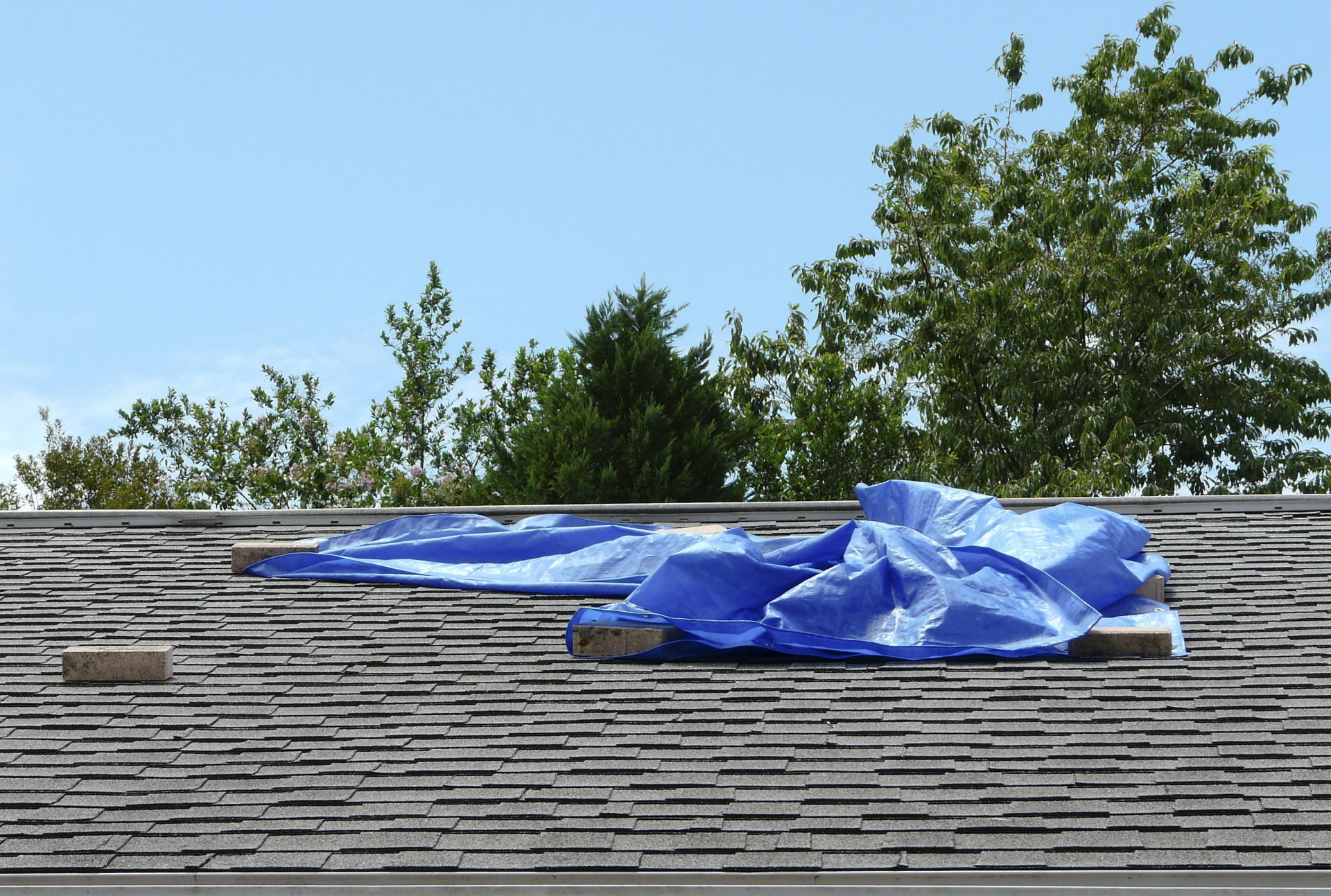
Temporary repairs — tarps, emergency sealants, spray foam bridging — are appropriate when permanent repair cannot be executed immediately due to weather, access constraints, or material lead times. But temporary repairs on commercial properties in Dayton need to be documented and followed up with permanent repairs before the next freeze cycle. A temporary sealant repair applied in September that holds through one winter does not mean the underlying condition has been resolved — freeze-thaw movement will typically fail a temporary repair within one to two seasons at most. Property managers who let temporary repairs slide into permanence are accumulating deferred maintenance that compounds into larger replacement costs.
The Dayton commercial roofing market sees a significant volume of leak calls from buildings along I-75 and I-70 corridor retail and industrial properties that changed ownership or tenants without a formal roof inspection at transition. New tenants discover leaks their first spring; new owners inherit problems the prior owner knew about. Pre-lease and pre-purchase roof inspections protect both parties, and a documented leak history is an important disclosure consideration for commercial properties in Ohio. When repair calls come from recently occupied buildings, investigators should look for evidence of prior patch attempts that indicate known problem areas.
Repair material selection for Dayton conditions should match the existing membrane chemistry. Applying an incompatible sealant or patch material is one of the most common errors in commercial leak repair — silicone sealants applied over EPDM, for example, do not bond reliably and can fail within a single freeze cycle. On BUR and coal-tar systems, material compatibility is especially important because coal-tar and asphalt products are not interchangeable. Permanent repairs should use manufacturer-approved materials and methods to preserve any remaining warranty coverage and ensure compatibility with the field membrane that will carry the repair through Dayton's temperature range.
Document the interior damage location precisely and note the weather conditions when the leak occurred. Then contact a commercial roofing contractor for a systematic leak investigation — not just a visual scan of the roof surface. On large flat roofs in Dayton, water entry points are frequently remote from the visible interior damage. Electronic leak detection systems can locate pinhole failures invisible to the eye. Flood testing specific roof zones in a controlled manner can also help isolate the entry point when other methods are inconclusive.
Commercial roofing contractors with active emergency response programs can typically respond to an initial assessment call within two to four hours during business hours for priority accounts. After-hours response for occupied facilities with active damage is available from contractors who maintain on-call crews during severe weather season. May through July is the peak demand period in Dayton — building owners without pre-established contractor relationships may experience longer response times during this window. Pre-qualifying a contractor before an emergency occurs is the most reliable way to ensure rapid response.
Standard commercial property insurance covers sudden and accidental damage — a hail event, a wind blow-off, or a branch puncture. It does not cover damage resulting from gradual deterioration, deferred maintenance, or pre-existing conditions. Adjusters in Dayton are experienced with storm claims and will look for evidence of pre-storm condition in their assessment. Documenting your roof's condition before storm season with inspection reports is the strongest protection for insurance claims. Leaks attributable to aging membrane or neglected maintenance are generally not covered.
A temporary patch is designed to stop active water entry until a permanent repair can be executed — it typically uses materials that do not require full surface preparation, primer, and curing conditions, and it is not expected to perform through a full seasonal cycle. A permanent repair restores the membrane to its designed performance specification using manufacturer-approved materials and methods, includes proper surface preparation, and is intended to last for the remaining life of the roof system. On Dayton commercial roofs, temporary patches applied before winter need to be evaluated in spring and replaced with permanent repairs if they survived only marginally.
Most WPAFB contractor facilities have an emergency maintenance protocol that allows faster contractor access than the standard background-check timeline. Facility security officers at defense contractor buildings are accustomed to coordinating emergency maintenance access — contact your FSO immediately when a leak is discovered and request emergency access authorization while simultaneously reaching out to your roofing contractor. Having your contractor's employee information pre-loaded in the facility's access management system eliminates the delay caused by processing contractor credentials during an emergency.
What to send before the roof walk
Send the roof address, leak photos, roof age if known, access instructions, tenant limits, prior reports, and the deadline driving the decision. That lets the first visit focus on the roof condition instead of chasing basic context.
Questions Owners Ask
Can this work happen while the building is occupied?
Often yes. The scope should cover access, safety, dry-in, staging, noise, interior protection, and the times when tenants or operations cannot be interrupted.
What changes the cost most?
Wet insulation, deck condition, edge metal, layer count, access, roof size, code triggers, weather timing, and the amount of repeated damage usually move the cost.
How is the condition documented?
The roof file should include photos, locations, material notes, observed defects, temporary repairs, remaining deficiencies, and recommended next steps.