
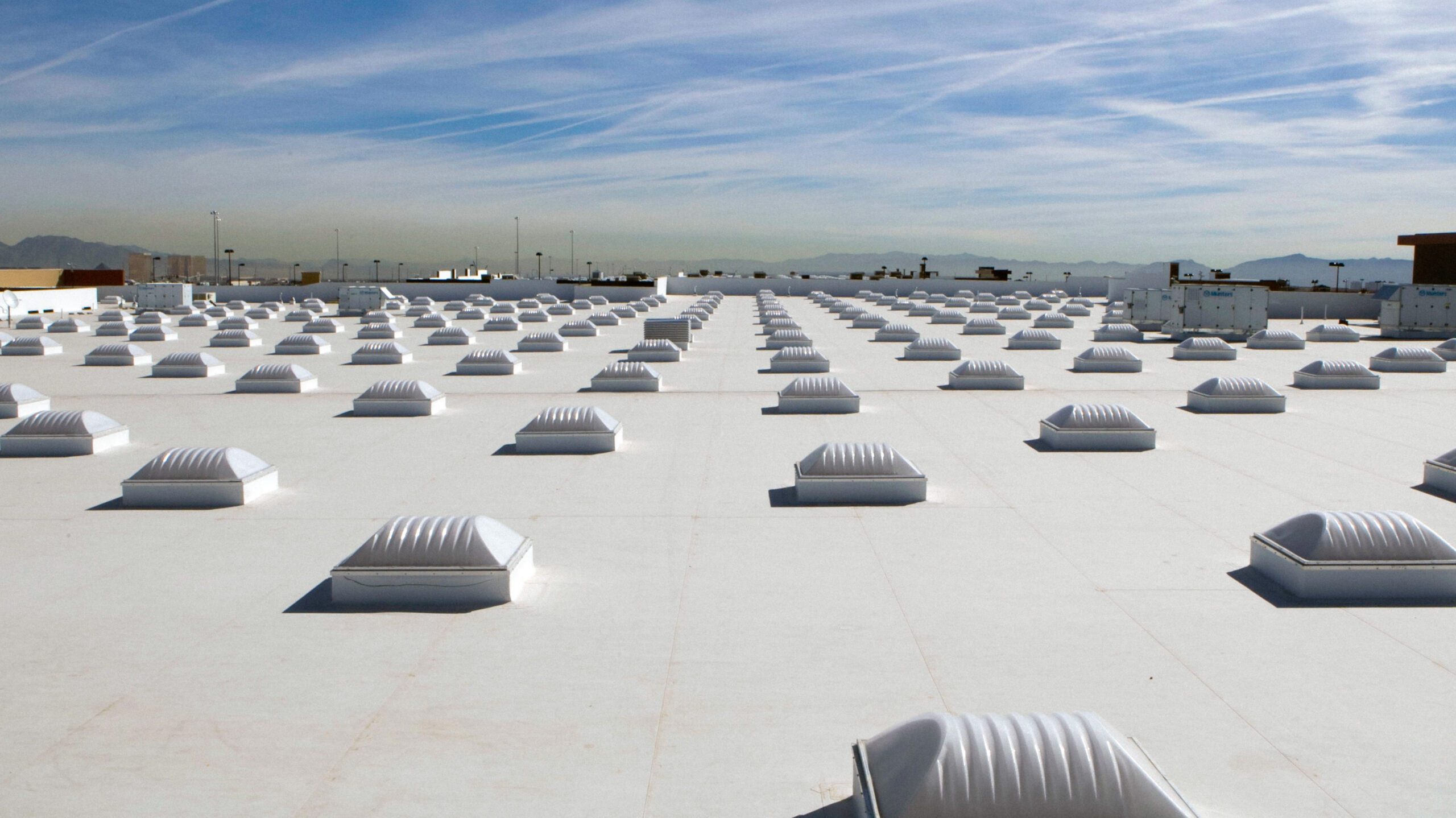
Energy-Efficient Cool Roof Installation for commercial buildings across Dayton, Montgomery County, Kettering, Beavercreek, Fairborn, Huber Heights, Vandalia, Miamisburg, Centerville, Springboro, Troy, Xenia, and the Miami Valley.
The energy case for cool roofing in Dayton requires an honest look at the local climate rather than marketing claims calibrated for Houston or Phoenix. Dayton sits in ASHRAE Climate Zone 5A — a mixed-humid zone where heating degree days (around 5,700 annually) substantially outnumber cooling degree days (around 900). The city averages approximately 25 days above 90°F per year, compared to 100-plus days in southern markets where high-reflectivity roofing delivers its most dramatic energy savings. Building owners in the Miami Valley should understand what cool roofing does and doesn't do for their specific energy profile before making it a primary selection criterion.
The thermal cycling reduction argument for white or light-colored roofing is more compelling in Dayton than the cooling-energy argument. When a standard dark membrane surface swings from 40°F on a January night to 140°F+ on a July afternoon — a 100-degree temperature cycle repeated daily throughout the seasons — the mechanical stress on membrane seams, flashing attachments, and fastener pull-through is substantial. A white TPO surface on UD Research Institute buildings or Beavercreek corporate campuses runs 20 to 40 degrees cooler on peak summer days than an equivalent dark membrane surface. That reduction in thermal cycling extends membrane service life and reduces stress on seam adhesion — a real performance benefit independent of the energy calculation.
Duke Energy Ohio commercial customers pay time-of-use or demand-based rates in many rate structures, which means reducing peak cooling demand has a value that goes beyond simple energy unit cost. On large institutional buildings with significant air conditioning loads — hospital campuses, large office buildings in the Austin Landing development, or the bigger Centerville retail anchors — a cool roof that reduces peak afternoon cooling load can provide modest demand charge reductions. The magnitude of the savings depends on the specific building's cooling system design, internal heat loads, and occupancy schedule, and should be modeled by an energy engineer rather than assumed from generic marketing calculations.
Cool roof requirements in Ohio's building code have evolved as successive editions of ASHRAE 90.1 have been adopted. New commercial roofing in Montgomery County must meet minimum solar reflectance and thermal emittance requirements depending on roof slope and occupancy type. TPO and PVC white membranes meet these requirements as manufactured, which is one reason they've become dominant on new commercial construction across the Dayton eastern suburbs — Beavercreek, Fairborn, Washington Township — where most new commercial development is occurring. Contractors and building owners should verify compliance with the current Ohio Building Code edition applicable to their project rather than relying on general knowledge.
The winter energy penalty for cool roofing is real but frequently overstated in discussions. A highly reflective roof that repels solar heat gain in summer also foregoes some passive solar heat gain in winter. In Dayton's climate zone, this winter penalty partially offsets the summer cooling benefit. Modeling studies for Zone 5A buildings consistently show that cool roofing produces a net energy benefit over the year, but smaller than in warmer zones. The net benefit is positive, which means there is no strong energy argument against white roofing even in Dayton's climate — the argument simply needs to be scaled appropriately rather than compared to Sun Belt performance data.
Industrial buildings in Northwoods Industrial Park and the Moraine corridor present cool roof opportunities specifically around production environment temperature control. Manufacturing and warehouse spaces without mechanical cooling rely heavily on the roof surface for thermal management — reducing solar heat gain through the roof surface can meaningfully reduce interior temperatures in unconditioned or minimally conditioned spaces. For metalworking facilities, automotive component manufacturers, or distribution warehouses along I-75, a cool roof coating or reflective membrane recover can provide worker comfort and product quality benefits beyond HVAC load reduction on conditioned spaces.
Cool roof maintenance in Dayton's climate includes attention to surface soiling, which is the primary factor degrading reflectivity over time. Dark rooftop equipment exhaust, air pollution from I-75 and I-70 corridor industrial activity, bird activity, and biological growth (algae and mold on rooftops that retain moisture from Dayton's precipitation pattern) all reduce the initial reflectivity of a white membrane. Acrylic roof coatings in particular are susceptible to dirt accumulation that can reduce solar reflectance by 20 to 30 percent within the first few years of installation. Periodic cleaning — a service that most Dayton commercial roofing contractors can perform — restores reflectivity and extends the useful cooling performance of the system.
Cool roof certification through the Cool Roof Rating Council (CRRC) is the standard by which membrane and coating reflectivity claims are verified. Products listed in the CRRC database have independently tested initial and aged solar reflectance and thermal emittance values. When evaluating competing proposals for cool roofing systems, verifying that specified products appear in the CRRC database with tested aged values (not just initial values) is the most reliable way to compare actual long-term performance across membrane brands. Some Dayton contractors specify off-brand or private-label membranes without CRRC-listed tested values, which makes independent performance comparison impossible.
The honest answer is: less than marketing materials from warm-climate markets suggest, but still a positive net benefit. Studies for Zone 5A buildings show net energy savings of 10 to 30 cents per square foot annually, depending on building type, existing insulation levels, and cooling system efficiency. On a 50,000 square foot building, that's roughly $5,000 to $15,000 in annual energy cost reduction. The savings are larger for buildings with inadequate insulation where a combined cool roof and insulation upgrade is performed. Commission an energy model for your specific building rather than applying national averages.
Yes — Ohio's current commercial energy code (based on ASHRAE 90.1) specifies minimum solar reflectance and thermal emittance requirements for new low-slope commercial roofing. The requirements are less stringent than those in warmer climate zones but they do apply. Most standard white TPO and PVC membranes meet the requirements as manufactured. Dark EPDM membranes typically do not meet reflectance requirements without a white coating. Consult the specific ASHRAE 90.1 edition adopted in Ohio for current requirements applicable to your project type.
If you're comparing a cool roof option against a dark membrane option of similar base cost, the incremental cost to choose the cool roof system is minimal (white TPO is priced similarly to gray TPO). In that case, payback is essentially immediate since you're not paying a significant premium for the reflectivity benefit. If you're considering retrofitting a cool coating over an existing dark membrane, payback periods depend on building size and cooling load — a range of 5 to 12 years is typical for a properly executed coating installation on a conditioned Dayton commercial building.
White elastomeric coatings can be applied over clean, sound EPDM membrane to improve reflectivity. The EPDM surface must be thoroughly cleaned, primed with an EPDM-compatible primer, and then coated with a system designed for rubber membrane substrates — silicone-based systems are common in this application. The substrate must be dry and in good condition; a coating over cracked, blistered, or ponding-area EPDM will not perform reliably. For Dayton buildings where the EPDM is within the latter half of its service life, a recovery with a white TPO cap sheet may provide better long-term value than coating an aging membrane.
Solar reflectance measures how much of the sun's energy the roof surface reflects away rather than absorbing — a value of 0.70 means 70 percent of solar energy is reflected. Thermal emittance measures how efficiently the roof surface re-radiates heat it has absorbed back to the sky rather than conducting it into the building below — values close to 1.0 are most efficient. Both values matter for cooling performance. A roof with high reflectance but low emittance will heat up less during the day but won't shed the heat it does absorb as efficiently. White TPO and PVC membranes typically score 0.70+ on reflectance and 0.87+ on emittance — both strong values for Dayton's commercial roofing applications.
What to send before the roof walk
Send the roof address, leak photos, roof age if known, access instructions, tenant limits, prior reports, and the deadline driving the decision. That lets the first visit focus on the roof condition instead of chasing basic context.
Questions Owners Ask
Can this work happen while the building is occupied?
Often yes. The scope should cover access, safety, dry-in, staging, noise, interior protection, and the times when tenants or operations cannot be interrupted.
What changes the cost most?
Wet insulation, deck condition, edge metal, layer count, access, roof size, code triggers, weather timing, and the amount of repeated damage usually move the cost.
How is the condition documented?
The roof file should include photos, locations, material notes, observed defects, temporary repairs, remaining deficiencies, and recommended next steps.