
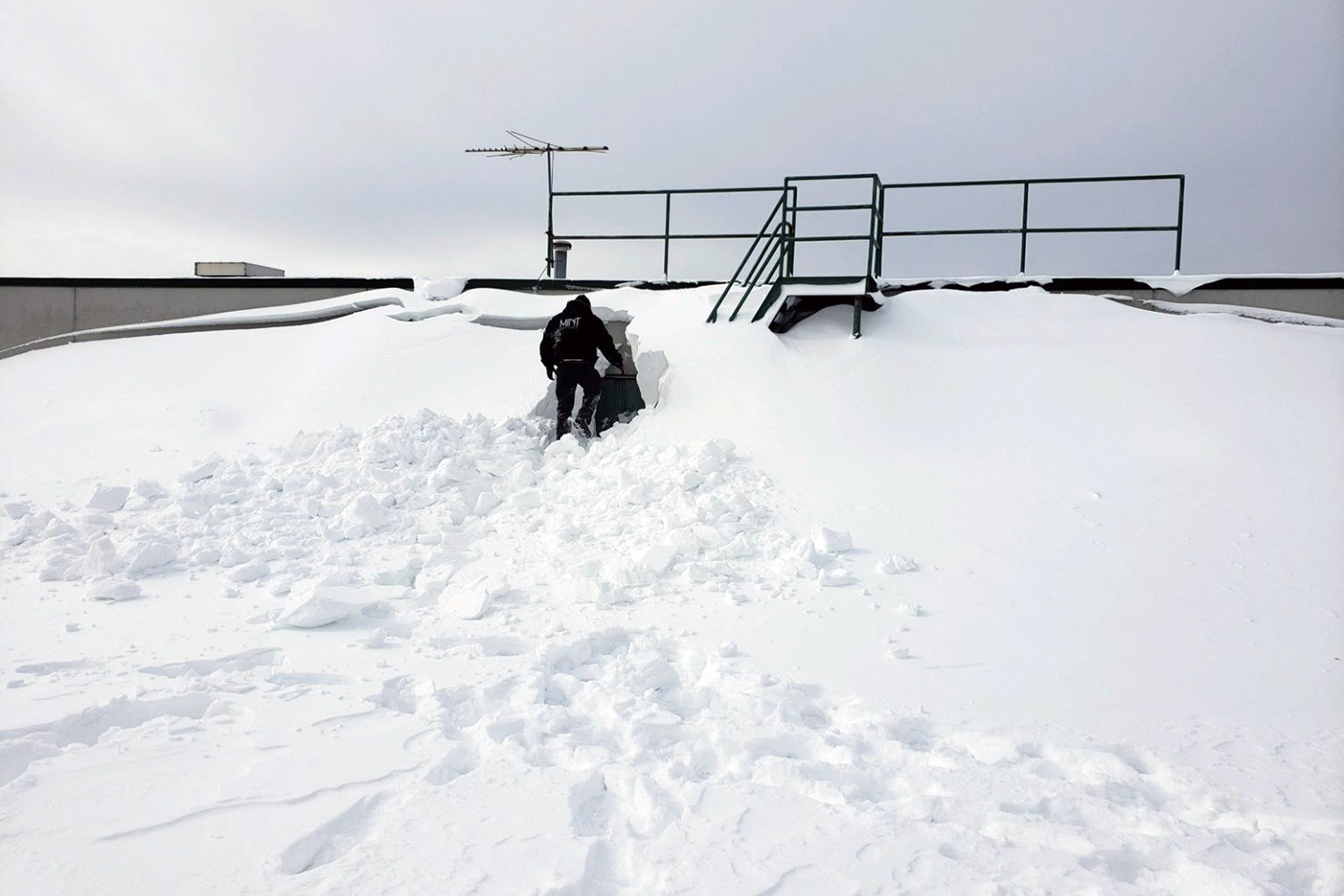
Snow and Ice Damage Roof Repair for commercial buildings across Dayton, Montgomery County, Kettering, Beavercreek, Fairborn, Huber Heights, Vandalia, Miamisburg, Centerville, Springboro, Troy, Xenia, and the Miami Valley.
Dayton's winter roofing damage profile is defined by January and February. Those two months deliver the majority of the Miami Valley's 25-inch annual snowfall — January at 8.3 inches average, February at 6.6 inches — and they combine snow loading with the freeze-thaw cycling that characterizes Ohio winters rather than the sustained cold that characterizes more northern markets. A Dayton winter is not like a Minnesota winter: temperatures regularly oscillate above and below the freezing point within a single week, creating melt-freeze-melt cycles that produce ice formation conditions across commercial rooftops repeatedly throughout the season. The damage this cycling creates is different from simple snow load and requires specific diagnostic and repair approaches.
Ice damming on commercial roofs in Dayton is an underappreciated failure mode because it's associated in most building professionals' minds with residential sloped roofs. But ice damming also affects flat and low-slope commercial roofing whenever conditions create a freeze differential across the roof surface: a warm interior below the roof, a cold ambient temperature above it, and snow as the insulating medium. On low-slope commercial roofs with inadequate insulation in certain zones — particularly near perimeter edge conditions where the insulation thins or terminates — snow melt can migrate toward drains and perimeters where the lower temperature re-freezes it. The accumulating ice at these zones backs up water under the membrane edge, entering the building at the most vulnerable transition points.
Downtown Dayton buildings and medical campus structures warrant priority response during and immediately after significant snow and ice events. The Oregon District's historic masonry buildings have parapet walls with stone or terra cotta coping that is vulnerable to ice formation between coping units — when water infiltrates a joint and freezes, the expansion force can dislodge coping units that have been in position for a century. Miami Valley Hospital and Dayton Children's Hospital operate continuously through winter weather events and cannot tolerate active roof leaks affecting clinical operations. These buildings and their neighbors along Patterson Boulevard and Wyoming Street represent the priority response segment for winter roof damage calls in the Dayton market.
Flashing failure from freeze-thaw cycling is the most common repair trigger in the January-April window across Dayton's commercial roofing market. The mechanics are cumulative: flashing sealants at parapet walls, pipe penetrations, and HVAC curbs degrade through repeated freeze-thaw cycling over multiple winters. Each cycle allows a small amount of additional water infiltration into the sealant joint, and each freeze event expands that water and slightly enlarges the gap. By the time active interior leakage is visible — which typically occurs after a particularly cold spell in January or February followed by rapid warming — the flashing condition has been deteriorating for multiple seasons. The visible leak is the end point of a gradual process that started with deferred sealant maintenance.
Snow load management on Dayton commercial roofs is primarily a design and drainage issue rather than an active removal issue for most building types — Dayton's snowfall is not typically of the magnitude that produces structural overloading concerns on code-compliant buildings. However, specific conditions warrant attention: buildings where HVAC equipment exhausts warm air that accelerates localized snow melt and refreezing, buildings with drainage systems that are partially blocked and accumulate water beneath snowpack, and very large flat-roofed buildings where multiple years of deferred insulation maintenance have created cold spots near drains where ice accumulation can be significant. Emergency snow removal from commercial roofs in Dayton is an occasional service requirement, most often triggered after the one or two major snow events per decade that significantly exceed normal accumulation expectations.
The spring repair season that follows Dayton's winter damage period — typically March through May — is the highest-volume repair period in the Miami Valley commercial roofing market. Flashing repairs, coping re-seating, pipe boot replacements, and membrane patching at perimeter conditions where ice backup caused infiltration all accumulate during the winter and require attention before May's heavy rain season begins. Building owners who proactively schedule a spring inspection and repair visit in late March or early April get ahead of the backlog that develops as local contractors work through all the winter-damage calls simultaneously. Waiting until May to schedule spring repair work means competing with the post-thunderstorm emergency calls that begin in that month.
Structural assessment after significant snow and ice loading events on older Dayton commercial buildings requires attention beyond the roofing membrane itself. Steel deck connections, bar joist bearing points, and structural frame members in older industrial and commercial buildings may have accumulated corrosion from years of minor water infiltration. A winter with above-average snowfall that produces ponding conditions as it melts can reveal structural distress in buildings that were marginally functional under normal loads. Any commercial building in Dayton that shows visible roof deck deflection — a sag or curvature in the roof plane — after a heavy snow event should be assessed by a structural engineer before roofing repair work proceeds, as the root cause may be structural rather than purely a roofing issue.
Emergency response prioritization during Dayton winter storm events follows a predictable hierarchy. Occupied medical and institutional buildings get first response because their continuous operations create the most urgent need and often the most severe consequences from untreated damage. Defense contractor buildings with active operations or sensitive equipment follow. Owner-occupied commercial buildings where the building owner is present and experiencing damage get faster response than vacant industrial properties where no one is at immediate risk. Building owners who have established pre-season contractor relationships — not just those who are calling cold into a contractor's queue during a storm — consistently receive faster response during the high-demand periods that Dayton's January and February weather regularly produces.
For most Dayton commercial buildings with properly designed and maintained roof systems, emergency snow removal is not necessary — Dayton's snowfall pattern is within the design load range for code-compliant commercial construction. Exceptions include: buildings with known structural deficiencies or deferred structural maintenance, buildings with blocked drains that are allowing water accumulation beneath the snowpack, very large flat roofs where above-average snowfall events significantly exceed normal accumulation, and buildings where the combination of snow load plus equipment load is approaching design limits. If you have concerns about a specific building, a structural engineer's assessment of your roof's design load capacity and current structural condition is the appropriate starting point.
Ice damming typically produces leaks at perimeter conditions — near exterior walls, at gutter lines, and at low-slope perimeter areas — rather than in the field of the roof. The leaks often begin or worsen during rapid thaw periods after sustained cold, as the ice dam releases water that has been backed up under the membrane. Interior water damage from ice damming tends to appear at the tops of walls and at the roof-wall transition area rather than at ceiling locations directly below the field of the roof. Regular freeze-thaw flashing failures produce similar timing patterns but are typically traceable to specific flashing conditions — pipe penetrations, parapet base flashings — rather than being distributed along the entire perimeter.
Spring inspection after a Dayton winter should specifically assess: sealant condition at all flashing terminations (coping joints, parapet wall flashings, pipe penetrations) where freeze-thaw cycling can open joints; edge metal and coping alignment and anchorage after potential ice-induced displacement; drain condition and flow capacity after potential ice and debris accumulation; membrane surface condition for any punctures or tears from freeze-thaw movement or snow removal activity; HVAC curb flashing integrity where snow packing around equipment bases can create localized moisture conditions; and any visible deflection or structural distress in the roof deck or parapet walls that may indicate structural loading effects from the winter season.
Some repair types can be executed in Dayton's winter conditions: sealant applications with appropriate low-temperature products (above 20°F), mechanical flashing reattachment, and emergency tarp or temporary membrane patching. Permanent membrane repairs requiring adhesive or torch application have lower temperature constraints — most require substrate temperatures above 40°F for reliable bond performance. Planning for permanent repair of winter damage during the spring window (March-April) rather than attempting to execute full permanent repairs in January or February conditions is typically the more reliable approach. Emergency temporary repairs in winter followed by permanent repairs in spring is the standard sequencing for Dayton commercial roofing winter damage response.
Manufacturer roofing warranties cover defects in material and workmanship — they do not cover damage from extraordinary weather events beyond the system's design parameters. Freeze-thaw cycling within the normal range for Dayton's climate (ASHRAE Zone 5A) is expected to be within the design scope of any commercial roofing system properly specified for this market. If freeze-thaw cycling is causing membrane or flashing failures on a relatively new system, that failure is more likely attributable to specification or installation deficiency (a potential warranty claim) than to weather conditions exceeding the system's design scope. Consult your warranty documentation and the roofing manufacturer's technical support team if you believe winter-related failures may have a workmanship or materials defect component.
What to send before the roof walk
Send the roof address, leak photos, roof age if known, access instructions, tenant limits, prior reports, and the deadline driving the decision. That lets the first visit focus on the roof condition instead of chasing basic context.
Questions Owners Ask
Can this work happen while the building is occupied?
Often yes. The scope should cover access, safety, dry-in, staging, noise, interior protection, and the times when tenants or operations cannot be interrupted.
What changes the cost most?
Wet insulation, deck condition, edge metal, layer count, access, roof size, code triggers, weather timing, and the amount of repeated damage usually move the cost.
How is the condition documented?
The roof file should include photos, locations, material notes, observed defects, temporary repairs, remaining deficiencies, and recommended next steps.