
Acrylic and Silicone Roof Coatings for commercial buildings across Dayton, Montgomery County, Kettering, Beavercreek, Fairborn, Huber Heights, Vandalia, Miamisburg, Centerville, Springboro, Troy, Xenia, and the Miami Valley.
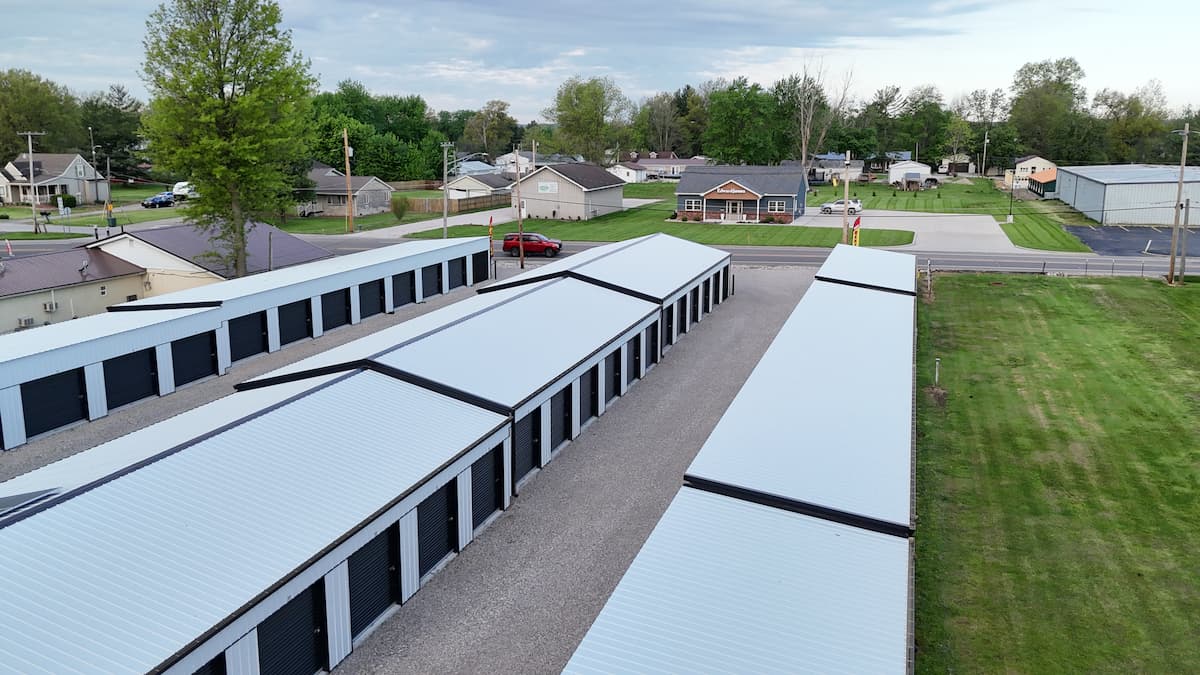
Dayton Self Storage on North Springboro Pike is one of the larger independent storage operators in the Miami Valley, offering both climate-controlled and traditional drive-up units across a property that has expanded incrementally over the years. Like most Ohio self-storage facilities, the campus features the characteristic long, low-slope roof rows that define the building type — and those flat roofs face a punishment cycle that is distinctly different from what Texas or Florida operators contend with. In Dayton, the dominant roofing challenge is not heat alone or hurricanes alone, but the relentless freeze-thaw cycling that characterizes Southwest Ohio winters and the hail that follows close behind each spring.
Dayton's climate subjects commercial roofs to some of the most mechanically demanding conditions in the eastern United States. Winter temperatures drop well below freezing dozens of times per season, while warm fronts periodically push temperatures back above 40°F in the middle of January or February. Each freeze-thaw cycle expands water that has infiltrated any crack, seam, or lap in the roofing membrane, slowly prying open vulnerabilities that may not produce visible leaks until the following spring. A membrane that is slightly fatigued or has marginal lap seam integrity can survive several summer seasons before the Ohio winter finally opens it up. By the time the leak becomes obvious, the underlying insulation may already be saturated.
Wet insulation is the hidden cost of deferred roofing maintenance in Ohio. Polyisocyanurate insulation that absorbs moisture loses its thermal resistance rapidly — a board that provides R-6 per inch when dry may be delivering a fraction of that after a season of moisture infiltration. More critically, wet insulation creates ideal conditions for mold growth and structural deck deterioration. For self-storage operators whose tenants store fabric items, documents, and other moisture-sensitive belongings, a roof that is allowing slow moisture migration into the building envelope is a liability that extends well beyond the cost of roof repairs.
Hail rounds out the threat profile for Dayton self-storage roofs. The Midwest hail belt includes Southwest Ohio, and significant hail events occur every few years. Unlike the Gulf Coast where hail is primarily a spring phenomenon, Ohio can see damaging hail from late spring through early fall. After the Memorial Day weekend derecho that struck the Dayton area in 2019, numerous commercial roofs in the region required emergency repairs and full replacements. Storage operators who had maintained current roofing systems fared far better than those with aging membranes that the storm finished off decisively.
Modified bitumen roofing systems have historically been popular in Ohio for their excellent performance in cold weather conditions. APP-modified cap sheets with mineral granule surfaces provide natural hail resistance, and the multi-ply construction that characterizes most modified bitumen systems offers redundancy that single-ply membranes cannot match. Cold-weather installation flexibility is another advantage — properly formulated modified bitumen products can be installed in temperatures that would compromise TPO membrane welding. For Dayton storage facilities with year-round operational demands, the ability to complete emergency repairs in winter is a meaningful practical benefit.
TPO membranes have gained significant market share in Ohio as formulations have improved and installer expertise has deepened. Modern 60-mil and 80-mil TPO products perform well through Ohio freeze-thaw cycles when properly installed with fully adhered or mechanically attached systems that account for thermal movement. The reflective surface reduces cooling loads in climate-controlled units during Dayton's warm summers, and the weldable seam system provides strong lap bonds when installed by trained applicators. For new construction and complete replacements, well-specified TPO is a competitive option even in the Ohio climate.
Climate-controlled storage is growing in popularity throughout the Dayton market as customers recognize the value of protecting belongings from Ohio's temperature extremes. A unit that stays between 55°F and 80°F year-round requires a building envelope that can resist both summer heat and winter cold. Roof insulation is a key component of that envelope, and operators considering adding climate-controlled capacity should coordinate with their roofing contractor on the insulation specification needed to make HVAC equipment operate efficiently and economically.
Drainage design for Dayton storage facilities must account for both heavy rain events and snowmelt scenarios. Roof drains sized purely for rainfall intensity may not be adequate for a mid-winter thaw that combines accumulated snow melt with a significant rain event on top of still-frozen secondary drainage pathways. Working with a contractor who understands the compound drainage demands of Ohio winters prevents the structural overload scenario that occurs when flat roofs carry far more water weight than they were designed to handle.
Self-storage operators in Dayton who invest in quality roofing systems and maintain them proactively find that their roofs outlast industry averages by substantial margins. A well-installed modified bitumen or TPO system on a properly prepared deck, inspected twice annually and repaired promptly when minor issues are identified, can deliver 20 to 25 years of service life. In a market where roof replacement is a major capital expense, that kind of extended service life represents significant return on the original investment.
What to send before the roof walk
Send the roof address, leak photos, roof age if known, access instructions, tenant limits, prior reports, and the deadline driving the decision. That lets the first visit focus on the roof condition instead of chasing basic context.
Questions Owners Ask
Can this work happen while the building is occupied?
Often yes. The scope should cover access, safety, dry-in, staging, noise, interior protection, and the times when tenants or operations cannot be interrupted.
What changes the cost most?
Wet insulation, deck condition, edge metal, layer count, access, roof size, code triggers, weather timing, and the amount of repeated damage usually move the cost.
How is the condition documented?
The roof file should include photos, locations, material notes, observed defects, temporary repairs, remaining deficiencies, and recommended next steps.