
Roof Drains and Scuppers for commercial buildings across Dayton, Montgomery County, Kettering, Beavercreek, Fairborn, Huber Heights, Vandalia, Miamisburg, Centerville, Springboro, Troy, Xenia, and the Miami Valley.
Drainage capacity on Dayton commercial roofs is sized for a design storm event — typically a 10-year or 100-year return period rainfall intensity defined by local engineering standards. The problem with design storm sizing is that Dayton's severe thunderstorm season regularly delivers rainfall intensities that meet or exceed those design benchmarks. When a pop-up storm in July drops 1.5 inches of rain in 40 minutes — a documented Dayton occurrence — every flat roof in the storm track is experiencing a near-design-event drainage load simultaneously. On buildings where drains are undersized, partially blocked, or where the drain count hasn't kept pace with building additions that increased the tributary roof area, this load produces ponding that tests the structural and waterproofing limits of the system.
Freeze-over of roof drains is a January and February problem specific to Dayton's winter conditions that drainage system design doesn't always account for. When snow on a flat commercial roof melts during a mid-winter warm spell and then refreezes as temperatures drop again — a pattern that occurs multiple times each winter in the Miami Valley — ice accumulation at and around roof drains can completely block drainage. Standing water frozen in drain bodies, ice dams across scupper openings, and ice formation in interior drain leader pipes that run through unconditioned spaces are all mechanisms that disable drainage at precisely the moment when subsequent melt events require it. The practical result is backed-up water finding alternative pathways into the building at perimeter conditions or through compromised membrane areas.
The University of Dayton campus presents a large-scale version of the drainage complexity problem. The campus includes numerous buildings of varying age, size, and construction type, with drainage systems that range from modern purpose-designed interior drain layouts to original 1920s scupper-discharge systems retrofitted with interior leaders over multiple renovation cycles. When UD Research Institute buildings undergo reroofing, the existing drainage system capacity should be evaluated against current drainage design standards — not just assumed to be adequate because it has functioned (however marginally) for decades. Underdrained roofs on large institutional buildings in Dayton are a capital liability waiting for the season with above-average May precipitation to become an emergency.
Miami Valley Hospital's campus represents the high-consequence end of the drainage adequacy spectrum. Hospital buildings carry a specific risk profile for inadequate roof drainage: water accumulation on a hospital roof that breaches membrane perimeters or finds an entry pathway through aging drain hardware can flow into clinical spaces below, creating patient safety, infection control, and regulatory compliance situations. Hospital facilities management teams at major Dayton campuses treat drain maintenance and drainage system performance as a higher priority than it receives in routine commercial property management, and their annual maintenance programs typically include documented drain flow testing as a standard item.
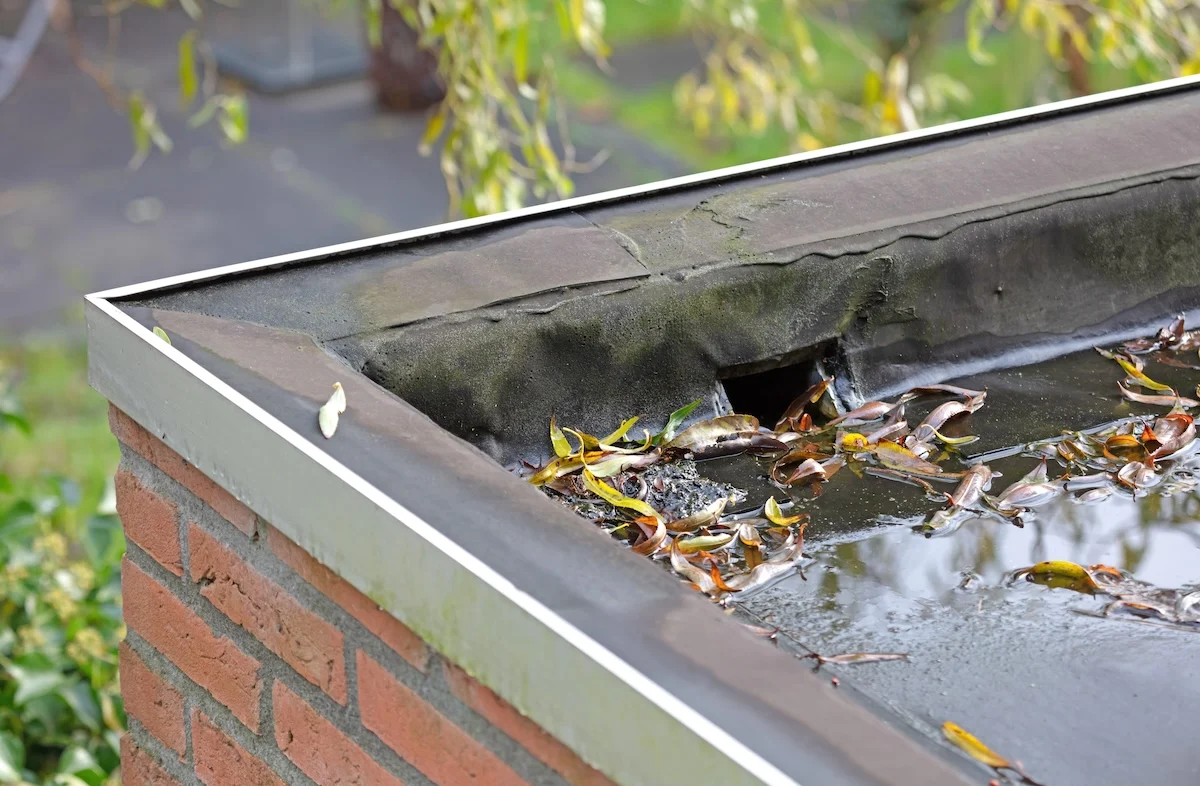
Scuppers — through-parapet wall drainage openings — are the alternative to interior drain systems on buildings with parapet walls. Scuppers are simpler mechanically, less vulnerable to debris blockage in the drain body itself, and eliminate the interior drain leader system that can freeze or fail independently of the roof surface. The challenges with scuppers in Dayton are: ice backup at scupper openings during freeze-over events, inadequate scupper sizing on older buildings (scuppers were frequently undersized on original construction), and waterproofing continuity at the scupper-to-parapet interface, which is a common source of water infiltration on aging buildings. Emergency overflow scuppers — set slightly higher than the primary drain elevation — are required by building code to prevent catastrophic ponding if primary drains fail; older Dayton commercial buildings frequently lack these emergency overflow provisions.
Drain clamping ring maintenance is a routine item that building managers on older Dayton commercial buildings frequently neglect. The clamping ring secures the membrane into the drain body and maintains the waterproof connection between the roofing membrane and the drain hardware. Over time, clamping ring bolts corrode or loosen in Dayton's freeze-thaw environment, and the membrane-to-drain seal degrades. A drain with a loose clamping ring that allows the membrane to lift away from the drain body perimeter is an active leak source, even if the drain itself is otherwise clear and functional. Annual inspection should include tightening or replacing clamping ring hardware as a standard item on all roof drain locations.
The relationship between drain spacing and ponding on large, flat commercial roofs follows from basic hydraulics: more drains with shorter tributary areas drain faster than fewer drains with larger tributary areas. On large industrial roofs in Northwoods and Ascent Industrial Park — 100,000 to 300,000 square foot flat roofs with drain spacing determined by 1980s engineering that may have used conservative design storm assumptions — the drainage system may be technically code-compliant but still produce significant ponding durations after major Dayton thunderstorm events. Adding drain locations as part of a reroofing project — either new interior drains or scupper additions — is an investment that pays back in extended service life of the new membrane and reduced risk of ponding-related structural overload events.
Downspout and leader pipe routing for roof drains in Dayton commercial buildings presents a freeze concern in buildings where leader pipes run through unconditioned spaces — crawl spaces, unheated service areas, or exterior-mounted drain leaders in exposed locations. A drain leader that freezes solid in January blocks the entire drain system it serves for the duration of the freeze event. Heat trace systems on vulnerable leader pipe sections are an engineered solution used on Dayton commercial buildings where drain leaders pass through freeze-exposed zones. On buildings where heat trace isn't feasible, insulating the leader pipe section to delay (if not prevent) freeze events reduces the freeze-blockage duration during Dayton's cold snaps.
Minimum twice per year: once in spring after leaf-fall season debris has accumulated through winter, and once in fall before the leaf-fall season begins. Buildings in tree-dense areas — many of Dayton's established commercial neighborhoods and suburban office parks have significant tree canopy — may need quarterly or even monthly drain checks during peak leaf season. Buildings with gravel ballast roofing need drain cleaning more frequently because gravel migrates toward drains continuously. Post-storm drain checks after significant weather events should also be part of the maintenance protocol for buildings with known drainage marginal capacity.
An emergency overflow scupper is a drainage opening set at a higher elevation than the primary drains, designed to activate and discharge water if the primary drainage system is disabled by blockage or failure. Building codes require emergency overflow provisions to prevent catastrophic structural overloading from accumulated ponding. Many older Dayton commercial buildings were constructed before these requirements were codified or the requirements weren't enforced consistently. If your building lacks emergency overflow scuppers, adding them during a reroofing project brings the building to current code compliance and provides genuine protection against the scenario where primary drains are frozen or blocked during a major rain event.
The most effective approaches are heat trace (electric resistance heating cable installed at the drain body and the leader pipe throat), drain antifreeze inserts (metal or rubber inserts that keep a small clearance open through the drain body even when ice forms at the perimeter), and maintaining adequate interior heat in the building to prevent the roof surface near drain locations from reaching freezing temperatures. For buildings with significant ponding conditions that exacerbate freeze risk, improving drainage slope toward drains — through tapered insulation added during reroofing — reduces the volume of water available to freeze at drain locations.
Yes — adding interior roof drains to an existing flat roof is technically feasible and commonly done as part of reroofing projects on Dayton commercial buildings with documented drainage deficiencies. The work involves core-drilling through the existing roof deck and ceiling structure, installing drain bodies with proper membrane tie-in, and running new leader pipe to the existing building drainage system. Connecting to the existing drainage system requires plumbing coordination and may require building permit approval. The cost of adding drains is a relatively small percentage of a full reroofing project budget, and the drainage improvement it provides significantly extends the service life of the new membrane on under-drained Dayton commercial buildings.
Odor from roof drains on commercial buildings typically results from dry drain traps — the water-seal traps in interior drain systems that prevent sewer gas from venting through the drain body into the building. On rooftop drain systems, traps that don't receive regular water flow can dry out over time, allowing sewer gas odors to migrate up through the drain system onto the roof surface or into the building. Adding periodic water to seldom-activated drain systems during routine maintenance keeps trap seals functional. On buildings where odor from rooftop drains has been reported, inspecting the drain trap condition and trap primer functionality is the starting point for diagnosis.
What to send before the roof walk
Send the roof address, leak photos, roof age if known, access instructions, tenant limits, prior reports, and the deadline driving the decision. That lets the first visit focus on the roof condition instead of chasing basic context.
Questions Owners Ask
Can this work happen while the building is occupied?
Often yes. The scope should cover access, safety, dry-in, staging, noise, interior protection, and the times when tenants or operations cannot be interrupted.
What changes the cost most?
Wet insulation, deck condition, edge metal, layer count, access, roof size, code triggers, weather timing, and the amount of repeated damage usually move the cost.
How is the condition documented?
The roof file should include photos, locations, material notes, observed defects, temporary repairs, remaining deficiencies, and recommended next steps.