
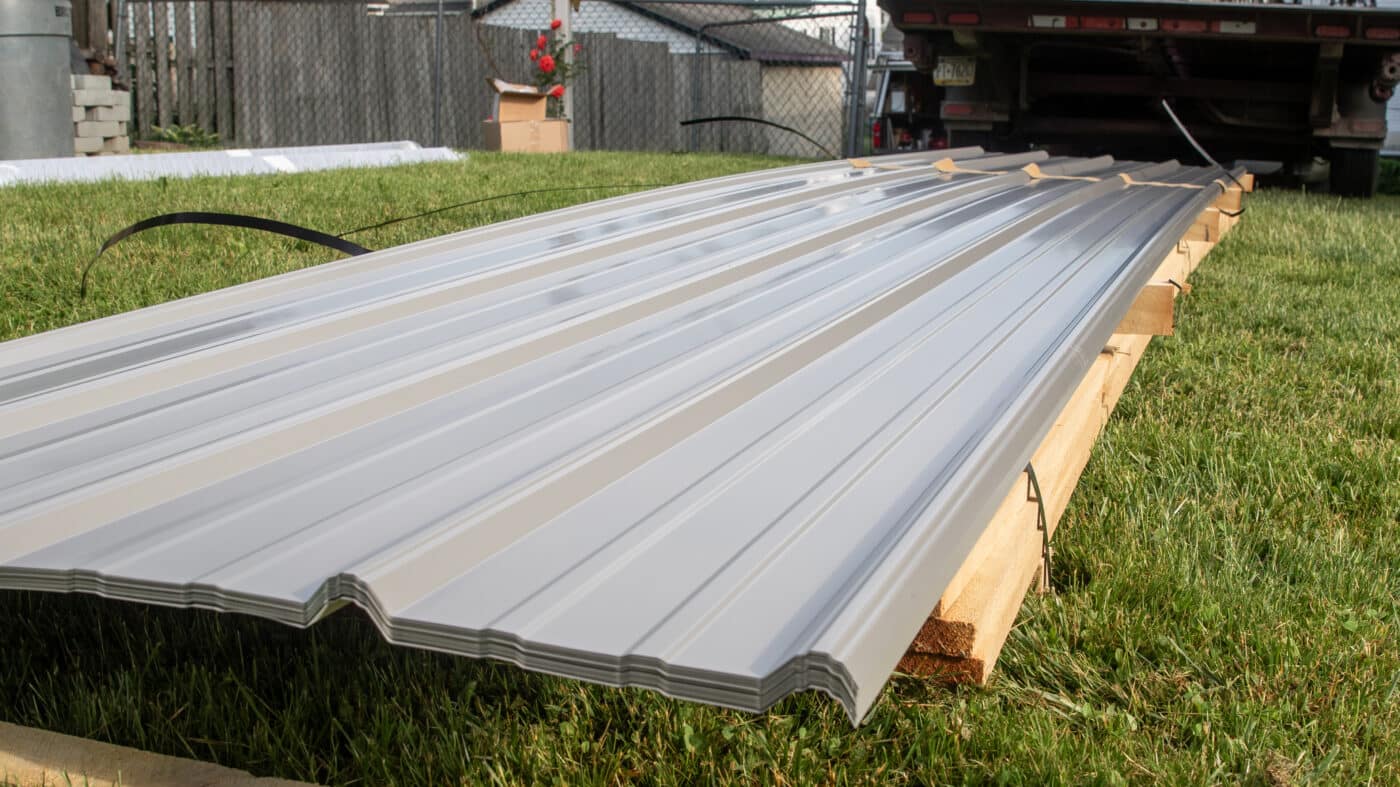
Commercial Metal R-Panel Roofing for commercial buildings across Dayton, Montgomery County, Kettering, Beavercreek, Fairborn, Huber Heights, Vandalia, Miamisburg, Centerville, Springboro, Troy, Xenia, and the Miami Valley.
Metal R-panel roofing — the exposed-fastener ribbed panel system that defines the visual character of industrial and agricultural buildings across the American Midwest — is ubiquitous in Dayton's industrial real estate corridors. Drive through Northwoods Industrial Park off Needmore Road, along the Byers Road industrial corridor, through the Ascent Industrial Park in Vandalia, or across the Moraine industrial district along I-75, and you're looking at square mile after square mile of R-panel roofing on warehouses, manufacturing facilities, flex industrial buildings, and distribution centers. Much of this stock was built during the industrial expansion of the 1980s and 1990s, which means a significant portion of the installed R-panel base in the Dayton metro is now 25 to 40 years old and approaching or past the point where major maintenance decisions are unavoidable.
Fastener backout is the chronic maintenance problem specific to exposed-fastener metal roofing in Dayton's freeze-thaw climate. Metal R-panels expand lengthwise as temperatures rise in summer and contract in winter — daily temperature swings from 20°F to 80°F during shoulder seasons create repetitive expansion-contraction cycles that gradually work hex-head fasteners upward out of the panel and substrate. A fastener that was flush at installation in 1995 may be backed out an eighth of an inch or more today, with its neoprene sealing washer compressed out of position. Backed-out fasteners allow water to enter directly into the panel-purlin interface and eventually through the roof deck below. Annual inspection and fastener tightening programs — or fastener replacement with oversized fasteners in stripped holes — are routine maintenance items on Dayton's aging R-panel inventory.
Panel sealant at end laps and ridge caps is the second critical maintenance item on aging R-panel roofing in the Miami Valley. Factory-applied butyl tape sealant at panel overlaps hardens and loses adhesion over time, typically beginning to fail after 15 to 20 years in Dayton's temperature cycling environment. Open end-lap joints allow wind-driven rain infiltration at the joint itself and allow water to wick along the panel rib profile into the building interior. Ridge cap and eave trim sealant deteriorates similarly. Before any significant weather event — and particularly before the May-June thunderstorm season — building owners managing R-panel roofed industrial properties should have sealant conditions assessed and deteriorated joints re-sealed.
Panel rust and corrosion on Galvalume or painted steel R-panel is a Dayton-specific concern tied to both the climate and the industrial environment. Galvalume steel has excellent corrosion resistance in clean environments, but cut panel edges — at eaves, ridges, and penetration cuts — are not protected by the zinc-aluminum coating and are vulnerable to rust initiation. Panel-on-panel contact at overlaps, where the factory coating is abraded by the assembly process, creates similar edge-corrosion vulnerability. In industrial areas near Moraine, where historical manufacturing activity has contributed to localized acid deposition and corrosive airborne compounds, panel corrosion rates can be higher than in purely commercial environments. Regular inspection of panel edges, overlap zones, and areas around penetrations identifies corrosion in the early stages when targeted repair is practical.
The decision between re-coating an aging R-panel roof and installing a new metal or single-ply recovery system is one of the most frequent capital decisions Dayton industrial property owners face. For R-panel roofing with sound panels, minimal corrosion, functional fasteners, and a substrate that has not been compromised by water infiltration, silicone or acrylic roof coatings applied over the cleaned panel surface can extend service life by 10 to 15 years at substantially lower cost than a full replacement. For R-panel roofing with widespread fastener failure, significant panel corrosion, or substrate damage from long-term infiltration, a recovery system — installing a single-ply membrane over a recovery board placed over the existing panels — provides a more durable long-term solution.
New R-panel installation on Dayton industrial buildings follows the same specification logic as any metal roofing: gauge selection, coating type, fastener specification, and purlin spacing all affect performance and service life. For industrial buildings in the Moraine corridor where roof loads include occasional equipment access and forklift-related vibration transmission through the structure, heavier gauge panels (26 ga. or heavier) provide better resistance to foot traffic damage and vibration-related fastener loosening. For buildings with significant chemical exposure from adjacent manufacturing processes, fluoropolymer (Kynar) coatings on the panel surface provide better long-term corrosion resistance than standard polyester coatings at an incremental material cost that is usually justified over the 30-year service life.
Penetration details on R-panel roofing in Dayton industrial buildings — pipe penetrations, curbed HVAC units, skylight openings — are frequently the first areas to develop water infiltration on buildings that are otherwise in serviceable condition. Factory-fabricated pipe flashings for R-panel applications use lead, EPDM, or neoprene boots that seal around the pipe circumference. In Dayton's climate, the neoprene and EPDM material in these boots develops UV-related surface cracking within 15 to 20 years and loses its watertight seal. A building with 50 pipe penetrations — common on a large industrial building with multiple HVAC, plumbing, and electrical penetrations — may have 10 to 15 failing pipe boots that are producing slow infiltration without any obvious interior leak signal. Pipe boot replacement is a targeted, cost-effective maintenance activity that addresses a significant source of latent infiltration on aging Dayton industrial roofs.
Energy code compliance for R-panel roofing in Ohio requires insulation installed at the thermal plane — either above the deck or as continuous insulation at the purlin level. Standard un-insulated R-panel construction that was common in Dayton's early industrial park development would not meet current Ohio energy code requirements for new construction. When significant reroofing projects are triggered on these buildings, the energy code compliance question needs to be addressed: bringing an existing building's roof assembly into compliance with current insulation requirements may be required as part of the permit approval for the reroofing project. Experienced Dayton commercial roofing contractors understand the current Ohio energy code requirements and can advise on the specific compliance path for a given building renovation scope.
Annual inspection is the recommended interval for exposed-fastener R-panel roofing in Dayton's freeze-thaw climate. The spring post-thaw window — April and May — is the best time to assess fastener conditions because the winter's full cycle of freeze-thaw movement has just completed and backed-out fasteners are most visible. Buildings where the roof was installed more than 20 years ago should have a comprehensive fastener condition survey done with spot-check torque testing rather than just visual inspection, since visually flush fasteners can have compromised neoprene washers that no longer provide a watertight seal.
Yes — R-panel recover systems using a recovery board over the existing panels followed by a single-ply membrane are a well-established approach for aging Dayton industrial roofs that are still structurally sound but have reached the maintenance-intensive phase of their service life. The recovery board layer bridges the panel rib profile and provides a smooth, flat substrate for the membrane. The existing panels must be assessed for structural adequacy to carry the additional dead load of the recovery assembly, and all backed-out fasteners must be addressed before the recovery board is installed to provide a stable substrate. The resulting assembly typically qualifies for a new manufacturer warranty on the single-ply membrane layer.
Galvalume (zinc-aluminum alloy coated steel) provides superior cut-edge corrosion resistance and long-term coating durability compared to standard G-90 galvanized steel, making it the preferred substrate for most commercial and industrial R-panel applications in the Dayton market. Painted steel — Galvalume or galvanized with a factory-applied paint system — provides color and additional UV protection. The quality of the paint system matters significantly for longevity: Kynar 500 fluoropolymer coatings (30-year paint warranties from major manufacturers) substantially outperform standard polyester coatings in Dayton's UV and freeze-thaw environment. Specify the paint system warranty explicitly rather than assuming all "painted steel" panels have equivalent coating durability.
Ridge cap dripping after heavy rain is almost always a sealant failure at the ridge cap-to-panel interface or at the end-laps of the ridge cap sections. The factory-applied closure strips and butyl tape sealant at the ridge cap have typically hardened and separated after 15-plus years of thermal cycling. The repair involves cleaning the existing sealant, applying new compatible butyl tape or urethane sealant at the ridge cap base, and ensuring the ridge cap fasteners are secure. On older buildings where the ridge cap itself is corroded or deformed from multiple freeze-thaw cycles, replacement of the full ridge cap assembly is more cost-effective than repeated sealant repairs.
Commercial roofing projects in Moraine, as throughout Montgomery County, require building permits for new roof systems and major reroofing work. The City of Moraine has its own building department for properties within city limits. R-panel installation or recover projects that add significant dead load to the existing structure may require structural review as part of the permit process. Energy code compliance documentation — showing that the insulation assembly meets current Ohio commercial energy code — is typically required as part of the building permit application. Your roofing contractor should handle permit application as a standard part of project setup, not as an add-on service.
What to send before the roof walk
Send the roof address, leak photos, roof age if known, access instructions, tenant limits, prior reports, and the deadline driving the decision. That lets the first visit focus on the roof condition instead of chasing basic context.
Questions Owners Ask
Can this work happen while the building is occupied?
Often yes. The scope should cover access, safety, dry-in, staging, noise, interior protection, and the times when tenants or operations cannot be interrupted.
What changes the cost most?
Wet insulation, deck condition, edge metal, layer count, access, roof size, code triggers, weather timing, and the amount of repeated damage usually move the cost.
How is the condition documented?
The roof file should include photos, locations, material notes, observed defects, temporary repairs, remaining deficiencies, and recommended next steps.