
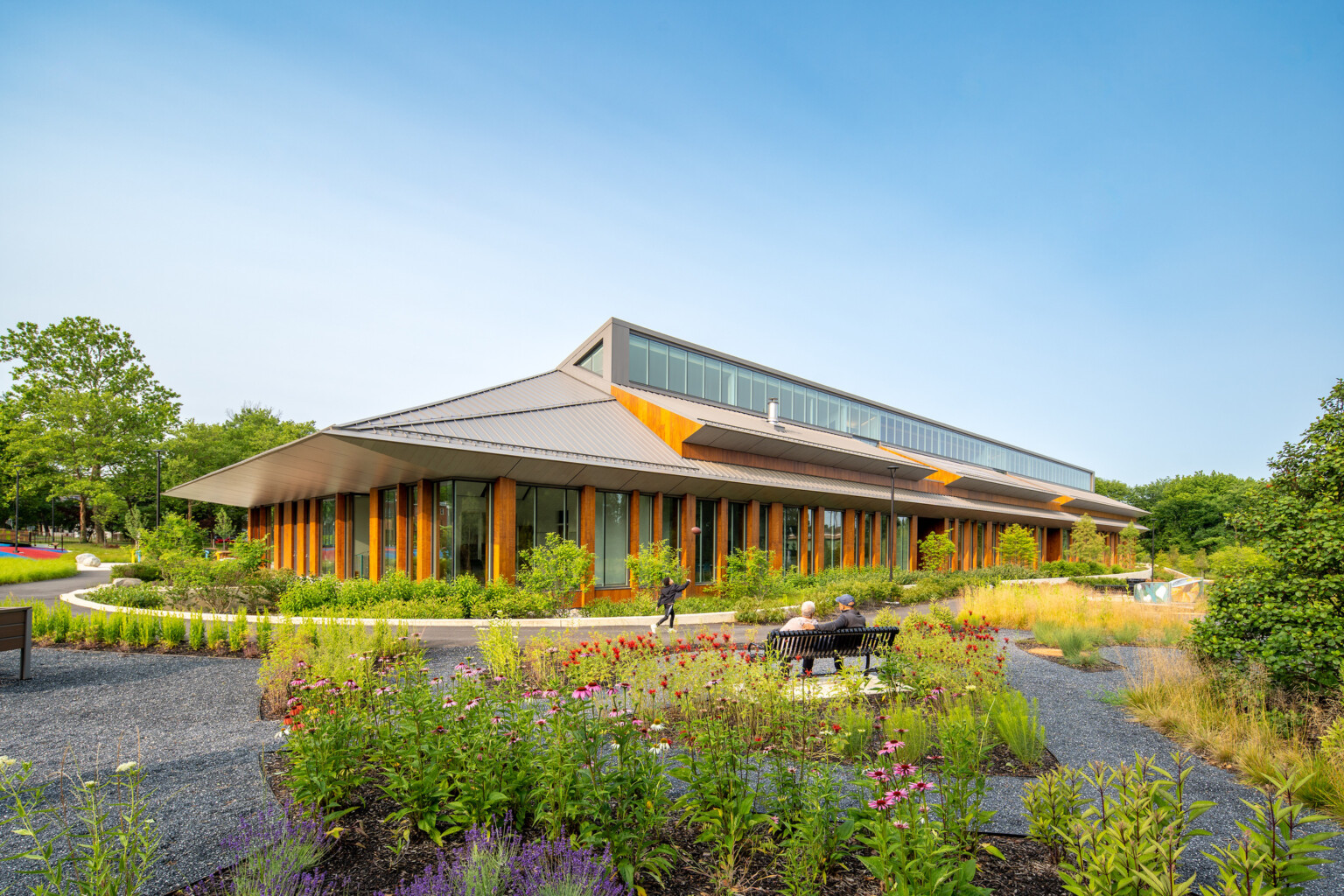
Big Open Spans and Wet Air Define These Roofs
Recreation buildings are a roofing category of their own because of two things almost every other commercial roof avoids: enormous clear-span structures with nothing holding the middle up, and interior air that is constantly loaded with moisture. Gymnasiums, field houses, ice rinks, fitness complexes, and aquatic centers across the Dayton area all share that DNA. We work on this building type throughout the region — from municipal and metro-park recreation centers and the Y branches serving Kettering, Huber Heights, and Centerville, to school and university athletic buildings tied to the area's strong sports footprint and the private fitness clubs along the suburban retail corridors.
The other thing that sets rec facilities apart is when they are busy. League play, lap swim, group fitness, and tournaments fill the evenings, weekends, and holidays — exactly the hours most roofers would rather not be on site. We plan around the programming calendar instead of fighting it, because a closed gym or pool on a Saturday is a real disruption to the people who run the place.
Long Clear Spans Need Engineered Attachment
A gym or arena roof can span 80 feet or more with no intermediate support, and that changes how the roof has to be attached. The deck flexes and deflects under wind and snow in ways a short-span office roof never does, and the fastening pattern has to be calculated for the actual deck type and span — steel deck at 80-foot bays pulls on fasteners very differently than the same deck at 30 feet. We do not carry a generic gymnasium detail across every building. We evaluate the deck and span and provide the fastener pull-out and uplift specification that matches the structure in front of us, so the membrane stays attached when an Ohio winter storm loads it down.
Vapor Drive From High-Occupancy Spaces
A packed gym, a locker room, and especially a pool put a heavy moisture load into the air, and that vapor wants to drive up into the roof assembly. If the vapor retarder sits in the wrong place for the climate zone — or there is none — that moisture condenses inside the system and quietly soaks the insulation and corrodes the deck with no surface leak to warn you. We spec the vapor control layer for how the building is actually used and for Dayton's specific climate data, and on any reroof over a humid space we run a moisture survey first rather than recovering over an assembly that is already wet.
Natatoriums Are the Hardest Roof in This Category
An indoor pool is the most demanding roof we deal with under the recreation umbrella, and it is the one where a generic spec does the most damage. Chlorine reacting with organics in the water releases chloramine gas, which is highly corrosive — it eats standard steel and aluminum flashing, attacks some membrane adhesives, and degrades ordinary edge metal. Over a natatorium we specify flashing in stainless steel or copper where chloramine reaches it, confirm membrane and adhesive compatibility against the manufacturer's chemical-resistance data, and make sure exhaust is designed to carry that air out of the building rather than recirculate it above the pool hall. The constant heat and humidity of the natatorium envelope only compounds the corrosion, so the whole assembly has to be chosen for that environment from the deck up.
Ice rinks bring the inverse problem — a cold interior under a warm, humid roof — and that combination drives condensation hard if the vapor and thermal layers are not designed for it. We treat rinks as their own assembly problem rather than lumping them in with a standard gym roof.
Skylights, Daylighting, and Penetrations
Field houses and rec centers lean on daylighting, so these roofs are full of skylights and translucent panels, and those openings are a frequent leak source as they age. Skylight curb flashing, panel replacement, and the seal between the daylighting system and the membrane are all part of how we scope these buildings. High-occupancy spaces also carry serious rooftop HVAC for ventilation and dehumidification, and every one of those curbs gets detailed individually rather than treated as a uniform field.
Heavy Rooftop HVAC and the Weight It Adds
A building that packs hundreds of people into a gym or a pool hall needs serious air handling to keep it comfortable and to control humidity, and that equipment lands on the roof. Large dedicated dehumidification units over natatoriums, big rooftop air handlers over arenas and field houses, and the ductwork and gas piping that serve them put real concentrated weight on a long-span deck that is already working hard to carry snow across its clear span. Before we sign off on a new or replacement unit, we look at whether the deck and structure can carry it where it is going, because a heavy curb dropped onto an undersized bay is a structural problem, not just a flashing one. We detail each of those curbs for the load and the airflow it sees, and we keep service walkways to them so the membrane is not getting beaten up every time a tech goes out to the equipment.
Protecting What Is Underneath During the Work
What sits below a rec-center roof shapes how we work above it. A gym floor is an expensive maple system that warps if it gets wet, a pool deck and the water itself cannot take falling debris, and a fitness floor is full of equipment and members. We sequence tear-off and dry-in so the space below is never left exposed to weather, protect or work around the floor and the pool surface, and keep the building watertight at the end of every shift. On occupied facilities we coordinate closely with staff so a section being worked is closed off cleanly and the rest of the building keeps running its programming without a safety question hanging over it.
Public Bids and Private Calendars
Many rec facilities in the Dayton area are publicly owned — city and metro-park centers, school gyms, university athletics — which means the roof gets contracted through public bidding, with bid and performance bonds and prevailing-wage compliance where it applies. We carry the bonding and insurance for public work in Ohio and know the documentation those contracts demand. Private clubs and fitness chains contract differently but bring their own tight scheduling around membership hours and event calendars. We have worked both paths and plan the project to fit whichever one applies.
- Deck and span evaluation with fastener pull-out and uplift specification for long clear-span roofs
- Vapor control engineered for natatorium, locker-room, and high-occupancy moisture loads
- Stainless or copper flashing and corrosion-rated materials for chloramine exposure over pools
- Skylight and daylighting flashing addressed as discrete scope, plus individually detailed HVAC curbs
- Programming-calendar scheduling with daily watertight dry-in before evening use
- Public-bid bonding and documentation for municipal, park-district, and school facilities
Whether you run a municipal rec center, a school field house, a private club, or an aquatic facility anywhere in the Dayton area, reach out and we will get on the roof, survey for hidden moisture, and put together a scope keyed to the spans, the humidity, and the calendar your building actually lives with.
What to send before the roof walk
Send the roof address, leak photos, roof age if known, access instructions, tenant limits, prior reports, and the deadline driving the decision. That lets the first visit focus on the roof condition instead of chasing basic context.
Questions Owners Ask
Can this work happen while the building is occupied?
Often yes. The scope should cover access, safety, dry-in, staging, noise, interior protection, and the times when tenants or operations cannot be interrupted.
What changes the cost most?
Wet insulation, deck condition, edge metal, layer count, access, roof size, code triggers, weather timing, and the amount of repeated damage usually move the cost.
How is the condition documented?
The roof file should include photos, locations, material notes, observed defects, temporary repairs, remaining deficiencies, and recommended next steps.