
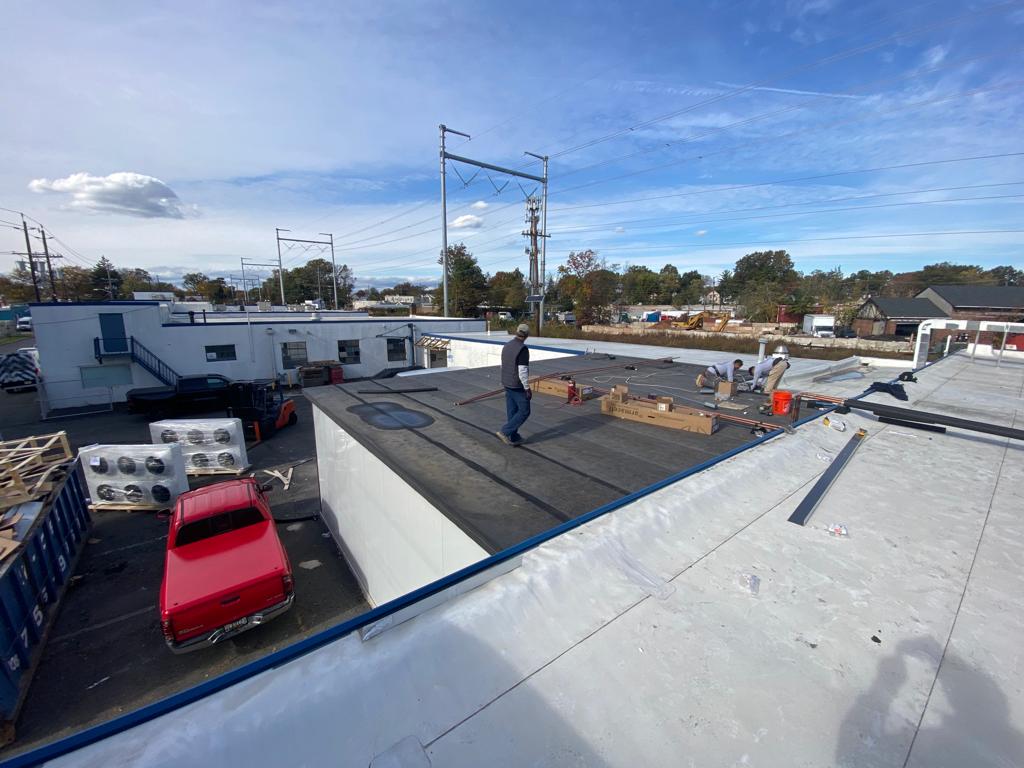
A Leak Over a Production Line Is a Food-Safety Event
On most buildings a roof leak is an inconvenience. Over an active food line it is a potential adulteration event that pulls in your QA team, can put product on hold, and lands in a regulatory file. We plan food and beverage roofing in Dayton to keep that from happening in the first place, not to react to it after the ceiling drips onto a conveyor. The Miami Valley has a deep food and beverage base — bakeries, dairy and frozen-food processors, snack and ingredient manufacturers, and co-packers clustered along the I-75 industrial spine and the rail-served sites toward Moraine and West Carrollton — and every one of them runs a roof that sits over a regulated environment.
Two things separate these plants from ordinary industrial buildings: the inside is wet and the schedule is unforgiving. Washdown sanitation pushes warm, moisture-laden air up into the roof assembly day after day, and the production calendar leaves only a narrow window when the floor below us is clean and idle. Both of those drive how we spec the roof and how we sequence the work.
Materials Have to Clear the Plant's Food-Safety Plan
Not every commercial roofing product belongs over a food-contact zone, and the spec for a processing plant starts with what is acceptable under the facility's USDA or FDA framework. White TPO and PVC single-ply are generally workable over enclosed production areas, but the specific product and installation method have to be confirmed against the plant's food-safety plan rather than assumed. The detail people skip is the accessory chemistry — primers, adhesives, and sealants used in flashings. Plenty of standard roofing adhesives are solvent-loaded and have no business above a production environment. We confirm the membrane and every accessory with your QA group before anything is specified for use over a food zone.
Washdown Humidity and Vapor Control
The constant interior humidity from sanitation washdown is what quietly destroys an under-designed roof assembly on these plants. That vapor wants to drive up into the insulation, and if the vapor retarder is in the wrong place for Ohio's climate — or missing entirely — it condenses inside the system, corrodes the steel deck, and saturates insulation with no leak ever showing on the surface. By the time it shows up as a stain, the deck underneath may already be compromised. We get the vapor drive right for a warm, humid interior pushing against cold Dayton winters, and on any recover we core and run a moisture survey first so we are not sealing wet insulation under a new membrane.
Refrigeration Loads and the Cold Chain
Frozen and chilled processing changes the roof problem on two fronts. First, the rooftop is loaded — condensers, large air handlers, and refrigeration equipment put real weight and a lot of penetrations on the deck, and the structure has to carry it. We confirm deck capacity before we add insulation thickness or sign off on new equipment curbs. Second, the assembly over a freezer or chill room has to maintain thermal continuity so you are not fighting condensation inside the roof and adding parasitic load to the refrigeration system. Tapered insulation over refrigerated bays gets designed around the actual operating temperatures and the vapor-drive direction, because getting it wrong corrodes the deck from inside while the surface still looks fine.
Drainage over refrigerated space matters more than people expect. Ponding water above a freezer adds thermal load the refrigeration system has to overcome and accelerates deck corrosion underneath. We slope drainage to perimeter scuppers or interior drains at the low point of each bay and confirm the layout works with how the space below is conditioned.
Sanitary Detailing at the Roof-to-Wall and Penetrations
Food plants are dense with rooftop equipment — exhaust hoods over cookers and fryers, makeup-air units, evaporative coolers, refrigeration lines, and process piping all break the roof plane, and grease- or steam-laden exhaust can degrade the membrane right around a hood if the curb and surrounding field are not detailed for it. We treat each penetration as its own watertight detail with adequate flashing height, and we keep accessory chemistry food-safe through every one of them. Roof-to-wall transitions get the same attention; on plants that have been expanded over time, the joints between old and new structure are a frequent leak source, and we address them rather than membrane over a moving crack and call it done. Where grease exhaust is heavy, we look at a membrane and walkway layout that protects the field from foot traffic and residue during the constant cleaning these roofs see.
Coatings and Recovers That Buy Time
Not every aging food-plant roof needs a full tear-off, and on a building where production cannot stop, it is worth knowing the options. Where the existing membrane is sound and the insulation tests dry, a silicone or acrylic restoration coating can extend service life, seal aging seams, and add reflectivity that takes load off rooftop refrigeration in the summer — all with far less rooftop disruption than a tear-off and no open deck over the line. We are honest about when a coating is the right call and when it is just postponing the inevitable. If coring turns up wet insulation or a corroded deck, we will tell you a coating is throwing money away, because sealing moisture into a food-plant assembly only accelerates the deck failure underneath.
Working Around a Running Plant
Food plants in Dayton commonly run two or three shifts with a weekly sanitation window as the only real opening over the production floor. We plan the phasing around your schedule rather than asking you to bend the plant to ours. Any work that opens the envelope above an active line is confined to those sanitation or shutdown windows, with the production team and QA confirming the floor is clean and protected before we start. Work over refrigerated areas is coordinated with your refrigeration maintenance crew so nothing we do disturbs the cold chain. We also stage materials and debris so nothing tracks toward intakes or open product areas, and we keep the roof clean as we go rather than leaving fasteners and scrap where a wind gust or a wash crew could carry them into the wrong place.
- Membranes and accessories confirmed acceptable under your USDA/FDA food-safety plan
- Vapor control engineered for washdown humidity and Ohio's climate, with moisture survey before any recover
- Deck-capacity verification for heavy refrigeration and rooftop equipment loads
- Tapered insulation and drainage designed around refrigerated bays and the cold chain
- Phasing centered on sanitation windows so production keeps running
- Condition documentation your QA team can produce during a USDA or FDA inspection
When water gets in over an active line, the first call is to your QA and facilities team for a product-hold decision and documentation — and we are set up to respond fast with priority dry-in and the records your incident reporting needs. Whether you run a bakery, a dairy, a frozen-food plant, or a co-packing operation in the Dayton area, reach out and we will scope a roof built for how a food plant actually treats one.
What to send before the roof walk
Send the roof address, leak photos, roof age if known, access instructions, tenant limits, prior reports, and the deadline driving the decision. That lets the first visit focus on the roof condition instead of chasing basic context.
Questions Owners Ask
Can this work happen while the building is occupied?
Often yes. The scope should cover access, safety, dry-in, staging, noise, interior protection, and the times when tenants or operations cannot be interrupted.
What changes the cost most?
Wet insulation, deck condition, edge metal, layer count, access, roof size, code triggers, weather timing, and the amount of repeated damage usually move the cost.
How is the condition documented?
The roof file should include photos, locations, material notes, observed defects, temporary repairs, remaining deficiencies, and recommended next steps.