
What "built-up" actually means, and why so much of older Dayton has it
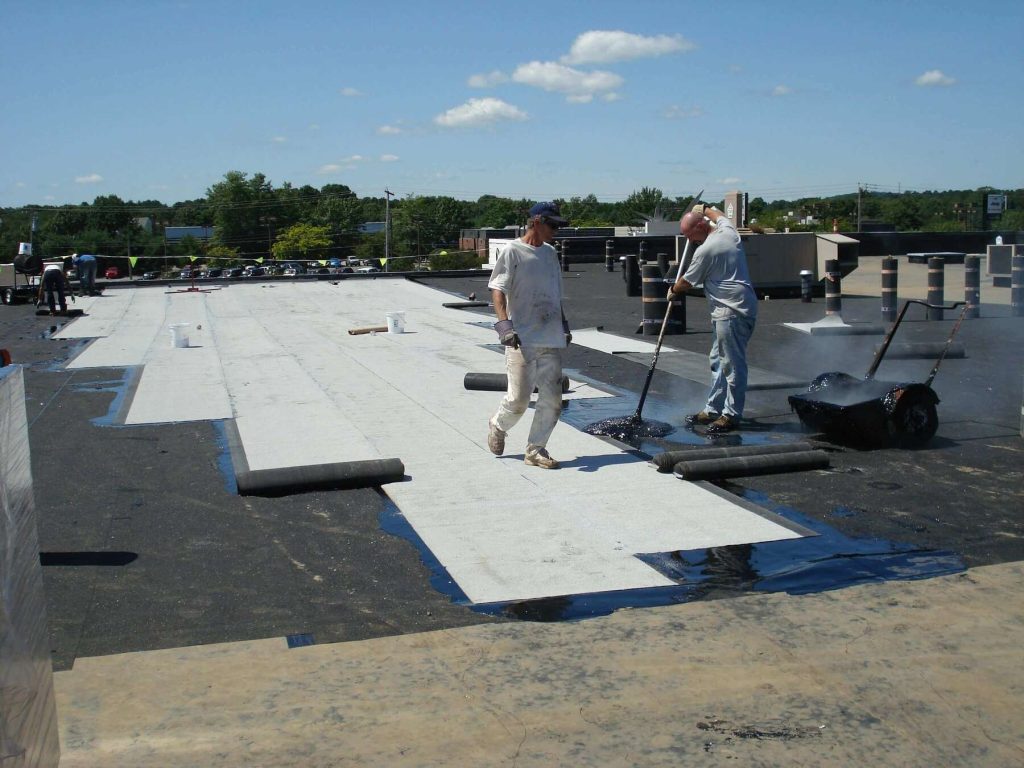
A built-up roof is built exactly the way the name promises: layer on layer, assembled in place. Several plies of roofing felt are bonded together in moppings of hot or cold-applied asphalt to form one thick, redundant membrane, and the whole thing is then surfaced — most commonly across the Miami Valley with a flood coat of asphalt and embedded gravel or slag. That gravel earns its keep. It armors the bitumen against ultraviolet light, which is the one thing that reliably destroys exposed asphalt, and it adds fire and hail resistance on top. A well-built, well-maintained four- or five-ply gravel-surfaced BUR is among the most durable low-slope assemblies ever installed on a commercial building, which is precisely why so many of the region's are still working decades later.
Spend any time on the older commercial stock here and you are standing on built-up roofing whether you can identify it or not. The mid-century warehouses in Old North Dayton and along the rail corridors, the institutional buildings near the University of Dayton, the masonry storefronts and offices that predate the single-ply era — a great many wear a BUR, often the original or a recover laid over it long ago. We are on these roofs constantly, and the first thing we want every owner to know is what is genuinely up there before anyone starts talking about tearing it off.
These roofs fail at the details and along the edges
A built-up roof rarely surrenders all at once. It gives way at its transitions and perimeters, and the Ohio climate works on it through every season. Freeze-thaw cycling over a Southwest Ohio winter flexes aging asphalt until it embrittles and the plies start to separate. Wherever the gravel has scoured off — windswept corners, traffic paths, the area downslope of rooftop equipment — the exposed asphalt oxidizes, hardens, and cracks. We routinely find alligatoring across bare flood coats, blisters where trapped moisture or air has delaminated the plies, splits opening along lines of building stress, and ridging telegraphing up from felt that has wrinkled beneath the surface.
The flashings are where most leaks genuinely begin. Base flashings at parapet walls and curbs, the pitch pans around old pipe penetrations, and the perimeter metal are usually older and stiffer than the field of the roof, so they crack and pull free first. Layer on Dayton's drainage reality — interior drains and scuppers that back up and refreeze through winter, ponding water resting on the dead-flat slopes these buildings were designed with — and the water finds the open seam, wicks into the felt, and travels sideways far from wherever the stain finally appears on the ceiling below.
What our first inspection puts on paper
- Ply count and surfacing type, confirmed by core cuts, so we know whether we are looking at an original BUR or a recover stacked on an older system.
- Blistering, ridging, splitting, and alligatoring across the field, each mapped to its location.
- Condition of base flashings, pitch pans, edge metal, and counterflashing — the usual points of entry.
- Drainage behavior and ponding lines, plus whatever interior leak history the owner can share.
- Moisture in the assembly, because a gravel-surfaced roof hides wet insulation completely from the surface.
Trapped moisture is the single fact that governs everything else
You cannot see water trapped beneath a flood coat and a layer of gravel, and that one limitation decides the repair-versus-replace question on every BUR we inspect. A roof can look uniformly weathered up top and be bone dry underneath — in which case targeted repair and ongoing maintenance is the right answer. The very same roof can be holding water across a third of its insulation, in which case patching the surface only seals the moisture in to keep rotting the deck and bleeding off the R-value. We confirm what is actually inside the assembly with core cuts, and on large roofs we pair the cores with thermal scanning to locate the wet zones, because the surface by itself will mislead you every time.
Four honest paths once we know whether it's dry
With the moisture question answered, the way forward is usually clear, and we walk owners through the real options rather than defaulting to the biggest one.
- Repair fits when the field is sound and dry and the trouble is localized: re-mopping open seams, cutting out and re-plying blisters and splits, rebuilding failed flashings and pitch pans, and resetting scoured gravel.
- Coat makes sense on a BUR with real life left — an asphalt-compatible reflective or aluminum coating restores the UV protection the gravel used to provide and buys meaningful years at a fraction of replacement cost.
- Recover is frequently the most cost-effective long-term move when the existing assembly is dry, structurally sound, and still within the number of roof layers code allows. Going over a sound BUR with new tapered insulation and a single-ply membrane skips the cost and disruption of a full tearoff while finally correcting the slope and drainage.
- Replace is the defensible call when the cores come back wet, the deck is compromised, or the roof already carries the maximum permitted layers and another recover is off the table.
The one option we steer owners away from is patching a saturated roof to postpone the inevitable — that spends money without buying a dry building.
Doing this work over a building that can't close
Most of the BUR roofs we touch sit over operations that cannot shut down: distribution centers, offices, institutional space. Hot-asphalt work brings kettles, fumes, and equipment that have to be staged around the tenants below, and any roof we open has to be dried in tight to the forecast before a Dayton thunderstorm or a winter system rolls in. We phase the work deliberately, protect entrances and air intakes, and size each day's open area to exactly what we can close before the weather turns. A modest section left open over a busy building can become an interior flood faster than the next break in the sky allows.
What owners ask us about built-up roofs
How do I even know if I have a built-up roof?
If the roof is older and surfaced with gravel or slag embedded in asphalt, it is almost certainly a BUR. A single core cut settles it for good — it reveals the plies, the surfacing, and whether a recover already sits on top of the original.
My BUR is leaking. Do I need a whole new roof?
Not on that alone. Plenty of BUR leaks trace back to one failed flashing, pitch pan, or open seam over an otherwise sound, dry roof. The deciding factor is whether the insulation underneath is wet, which we confirm with cores before recommending anything past repair.
Can I just coat it and move on?
If the field is dry and structurally sound, an asphalt-compatible reflective or aluminum coating can restore the UV protection the gravel once gave and extend the roof's life affordably. Over a wet or failing roof a coating only hides the problem, so the moisture check always comes first.
If the existing BUR is dry and sound and the building has not already hit the code limit on roof layers, recovering over it with new tapered insulation and a single-ply membrane usually costs less and fixes the drainage at the same time. Wet insulation, a failing deck, or an existing maximum layer count pushes the decision toward full replacement.
What to send before the roof walk
Send the roof address, leak photos, roof age if known, access instructions, tenant limits, prior reports, and the deadline driving the decision. That lets the first visit focus on the roof condition instead of chasing basic context.
Questions Owners Ask
Can this work happen while the building is occupied?
Often yes. The scope should cover access, safety, dry-in, staging, noise, interior protection, and the times when tenants or operations cannot be interrupted.
What changes the cost most?
Wet insulation, deck condition, edge metal, layer count, access, roof size, code triggers, weather timing, and the amount of repeated damage usually move the cost.
How is the condition documented?
The roof file should include photos, locations, material notes, observed defects, temporary repairs, remaining deficiencies, and recommended next steps.